Showing posts with label Southeast Asia. Show all posts

Wednesday, 3 October 2018

Biodiversity surveys on Gunung Slamet

Posted by Christian Devenish & Stu

After several months of preparation – obtaining permits and local permissions, appointing staff, buying equipment and sorting logistics - we were finally ready to start our mountain surveys to support placement of new protected areas or extensions of existing PAs in the uplands of Java (see previous post). The project, funded by Rainforest Trust, kicked off at Slamet, a large and biologically very important mountain in Central Java. This portion of the fieldwork is also supported by Chester Zoo who have a keen interest in bird species affected by the Asian Songbird Crisis.


Into the field (Photos: Gabby Salazar www.gabbysalazar.com)
The six week stint on Slamet started with some preparations in Purwokerto, a nice town of a quarter of a million folk to the south of the mountain. A visit to the local bird market was interesting – a lot of bird market surveys get done in Java and Sumatra, especially in the huge central markets like Pramuka market in Jakarta, and Bratang market in Surabaya. Perhaps ‘underwatched’ are the small provincial markets and town shops that presumably sell a lot of birds across Java. At Purwokerto, 10-12 shops and stalls had an interesting mix of the exotic and local.

Purwokerto bird market held a variety of birds - exotic lovebirds, the expensive Jalak Putih (Black-winged Myna), as well as locally-caught birds from Slamet (Photos: Gabby Salazar www.gabbysalazar.com)
Lovebirds of all colours made up an encouraging number (as they are captive-bred) of the birds for sale, as did Zebra doves and other columbids. Some of the more expensive species were also present – including a couple of Black-winged Mynas and White-rumped Shamas, and leafbirds both from Java and Sumatra. Other birds of particular conservation concern that were certainly wild-caught included Ruby-throated Bulbul (Vulnerable), Orange-spotted Bulbul (Near-threatened), and Chestnut-capped Thrush (NT). But there was a definite local flavour to the birds on sale – with species such as Mountain Leaf Warblers, tailorbirds, Little Pied and Indigo Flycatchers, and Rufous-tailed Fantail all said to have come locally from Slamet.


Fieldwork on Gunung Slamet (Photos: Gabby Salazar www.gabbysalazar.com)
Our team assembled in a hotel in Purwokerto – Christian and Stu from MMU, field ornithologist, Ridha Junaid, from Burung Indonesia, Rick Stanley and Gabby Salazar, experienced PhD students/wildlife recorders from USA, Ganjar and Arya, students from the local university, and guides Pak Karso, Pak Karbo and his son, and a team of porters – with all the equipment and rice, we were not travelling light. A quick trot through paddies and a waterfall recreational area – and we were at the forest edge, at around 700 m a.s.l. The northern side of the mountain is largely deforested below 2,000 m – hence our keenness to survey the steep southern slopes which have retained much of their forest, and we hope, its wildlife.

Javan Gibbons were recorded several times around 7-800 m (Photo: Gabby Salazar www.gabbysalazar.com)
Even from our camp close to the edge of the forest, we could see and hear both Javan Gibbons and Javan Hawk-eagles. We had several sightings in the local area, boding well for their populations on the mountain. During the first day, an important job was to test both the camera traps and audio recorders. Both sets of tech seemed to be working OK so we deployed all 14 recorders and 20 cameras along two transects ranging from 700 m to over 1,200 m a.s.l. This is quite low in the schemes of things at Slamet – perhaps more of the interesting and target species will be located higher up, perhaps in the 1,500-2,200 m altitudinal range. Nevertheless, some good sightings were had (Javan Trogon; Pin-tailed Parrotfinch), and good mixed flocks encountered which bodes well for fieldwork higher up the mountain. Less encouraging were accounts from local people about the extent of trapping on the mountain – the whole area appears to be peppered with small hunter trails and there seem to be very few places that are inaccessible to trappers.

Above - sonogram of Javan Gibbon caught on one of the recorders; Below - the real thing - audio associated with this record.

We left the team, having finished Site 1 on Mountain 1. The team has been joined by Bas van Balen and Fajar, a research assistant from Burung with experience camera trapping on Sumatra– they head further up the mountain on a different trail, spending around two weeks camping up as high as 2,200 m. The fieldwork on each mountain will be divided up into sites, each taking around a week to complete. After arriving and making camp, the first day will be spent in two teams positioning the audio recorders and cameras. Detailed habitat data will be gathered at each recorder location – details of tree girths, understorey density and presence/absence of a whole range of habitat features (e.g. bamboo, rattans).

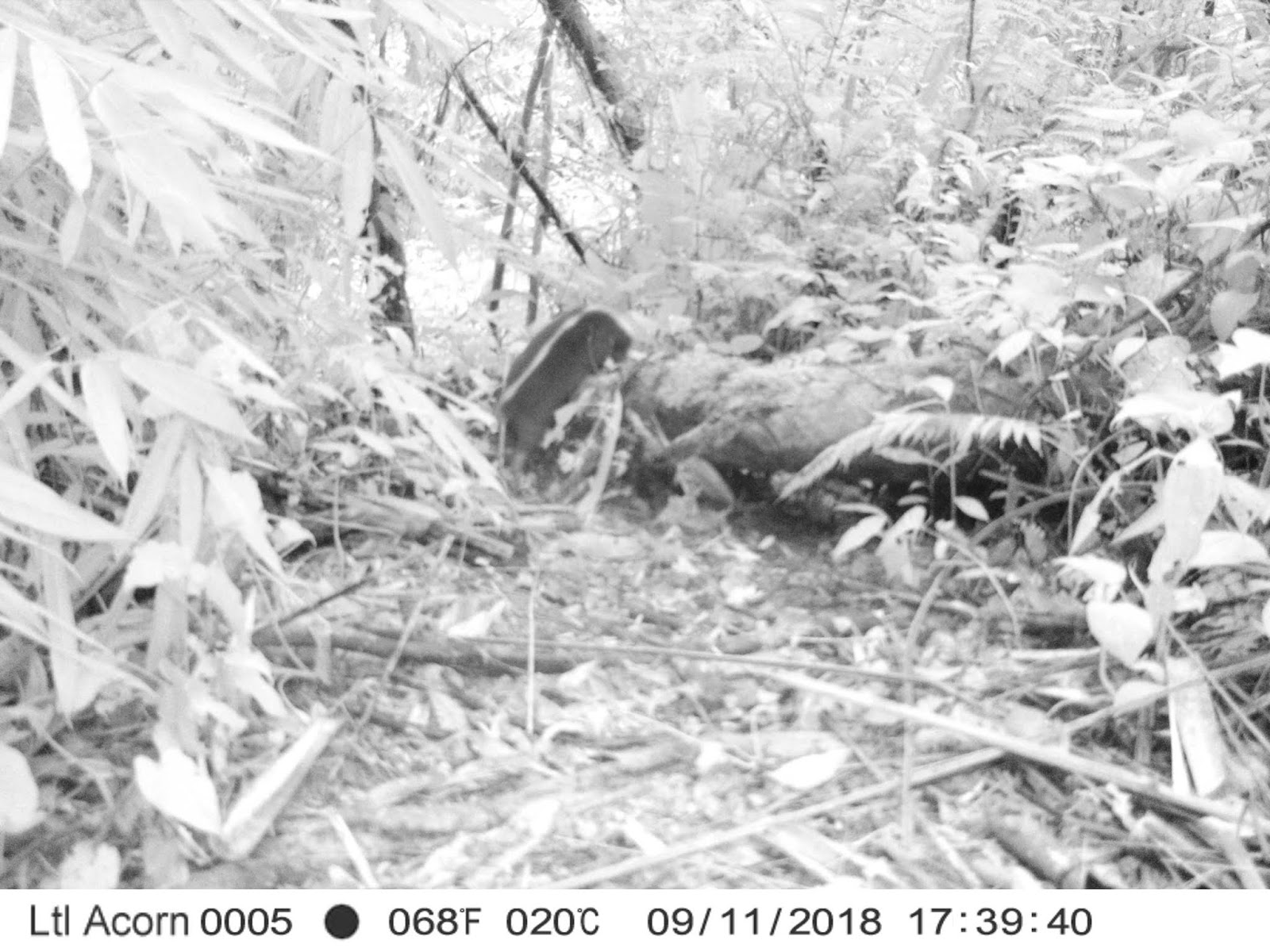
The first mammal caught on our cameras - the poorly known Sunda stink badger Mydaus javanensis
 The cameras and recorders will be left out to record constantly for three full days and nights so there will be terabytes of data to be analysed. That leaves around three days before taking the tech back in to search more extensively across the site for the key species of birds, mammals and frogs that we are targeting. We will record the GPS locations of these species and take habitat data from those points to allow us to build a picture of their spatial distribution, habitat requirements, and reaction to human pressures. All this, in turn, will, along with detailed socio-economic data from local stakeholders, feed directly into decisions about where additional protected areas should be ideally located to secure Java's most important montane wildlife populations.  


Monday, 1 October 2018

Heightening protection for Java's mountain wildlife

Posted by Stu & Christian Devenish

It is more than three years since Nigel Collar and I first discussed the need for extensive surveys of birds and other key endemic taxa across a whole range of mountains in West and Central Java. All of these mountains, including ones such as Gede-Pangrango which are well-known to many birders, are understudied, some have not been visited by biologists for half a century. This is a knowledge gap that needed to be filled quickly – the mountains are packed with Javan endemics; forest loss on most mountains has been significant, especially on their lower slopes; and heavy trapping for the cagebird trade has brought about reportedly precipitous declines in species such as Javan Green Magpie and Rufous-fronted Laughingthrush. 


Above - montane forest on Gunung Slamet; Below - the bird market at Purwokerto, Central Java (Photos: Gabby Salazar www.gabbysalazar.com)

Our recent review of ‘the state’ of West Java’s mountains including analysis of forest cover change (Higginbottom et al. in press), funded by the Shearwater Foundation, highlighted a series of around 20 mountains/blocks, all needing biological and socio-economic surveys fast. Coupled with this was a need and a desire by Indonesia’s Environment Ministry to consider expanding their protected area network in upland Java to better protect the country’s key species.


Maps showing the locations of mountains we intend to survey, and forest cover and loss since 1990 (from Higginbottom et al. in press)
A finding of our ‘Shearwater’ work was that forest inside of protected areas has indeed fared better than that outside of formal protection. This brought the project to the attention of Rainforest Trust, an NGO/Not for Profit which aims, through increasingly imaginative means, to expand the world’s protected area coverage. Finally, after much huffing and puffing, we are there – a four year project coordinated by Burung Indonesia, the BirdLife partner in Indonesia, which aims to identify priority areas for conservation in the Javan uplands – ones which have important populations of key species and habitats and the conditions under which these can be protected into the future – and to take one or more of these areas right through to designation as official protected areas.

Project preparations in the Burung office in Bogor with L>R Rick Stanley, Christian Devenish, Ria Saryanthi, Ridha Junaid & Stuart Marsden (Photo: Gabby Salazar www.gabbysalazar.com).
One of the first steps in this pipeline to protection is to conduct socio-economic studies in and around the candidate mountains, and to survey as well as we can the wildlife they contain. With up to 20 mountains to cover, this is no mean feat. We need to find out how local communities use the forest and perceive its value and how this might change under protection. We also want to know about patterns of bird trapping and which areas might serve as sanctuaries or release sites for threatened birds in the future. Not least we need to know which species from a range of taxonomic groups survive on which mountains, where they occur and in what kind of numbers in which habitats. We certainly cannot survey everything everywhere – so the choice of taxa, locations and methods have taken a great deal of thought. 
Capacity building in action. Above - Ridha (far right) joined our bird surveying workshop in Bogor as a student a couple of years ago. Below - Ridha talking birds with local students as a researcher on the Rainforest Trust project.


Finally, we have plumped for a system of week-long surveys at multiple sites within mountains. We have also decided on a fusion of controlled and relatively high tech surveys using remote cameras and acoustic recorders arranged along transects, and more extensive ‘quick and dirty’ encounter rate searches for key species. Records from the latter may feed into spatial distributional analyses (such as ENFAs) which will help to identify hotspots for protection at the local level. Key groups we are focusing on are birds of course, ground-dwelling mammals and primates such as Javan Gibbon, and selected amphibians.
 

Above - The fieldwork is quite tech-heavy compared to our usual projects. Below - We will be surveying remotely and actively birds, mammals and amphibians (Photos: Gabby Salazar www.gabbysalazar.com)


Our first survey has just started on Gunung Slamet in Central Java, the most easterly of our mountains and one that has special significance on account of its large size and relatively isolated position. With additional funding from our friends at Chester Zoo, we have around six weeks on various parts of the mountain. We have a team of 8-10  in the field comprising Ridha Junaid and a researcher from Burung Indonesia, Rick Stanley and Gabby Salazar, experienced PhD students/wildlife recorders from USA, two students from the local university (capacity building is a key component of the project), and Pak Karso and his excellent team of local guides. Periodically, they will be joined by Bas van Balen, Christian, myself and a whole series of other people over the next 18 months as they move from mountain to mountain. 


Wednesday, 13 September 2017

Myna miracle needed for Indonesia’s threatened starlings

Posted by Tom Squires

Trade-driven extinction threatens a growing number of Indonesia’s songbirds, as unsustainable trapping to supply the cagebird trade continues seemingly unabated (Eaton et al. 2015). In 2016, 19 of Indonesia’s bird species, all bar one songbirds, were uplisted to a higher extinction risk category on the IUCN’s Red List for birds. Indonesia is home to ten Critically Endangered species on the brink of extinction, primarily because of trapping. All except the helmeted hornbill Rhinoplax vigil, a species long-exploited for its ‘ivory’ casque, are traded as songbirds. In response to the significant and growing threat of extinction facing Southeast Asia’s songbirds, the first Asian Songbird Trade Crisis Summit convened in 2015 to devise a conservation strategy to tackle the issue.
 

Manchester Metropolitan University (MMU) and Chester Zoo developed two research projects that will focus on Indonesia’s cagebird trade (see Stu’s previous post). Tom’s PhD aims to understand the ecology and management needs of some of Indonesia’s most endangered birds that are affected by trade on the Indonesian islands of Java and Bali. Here, he introduces his research project and outlines its objectives.

Bratang bird market, Surabaya, East Java - not only can you buy songbirds, parrots and owls, but also reptiles, amphibians and mammals. (Photo: Tom Squires)

Unsustainable trapping to supply Indonesia’s domestic cagebird trade involves millions of wild birds annually and threatens an ever-increasing number of species with extinction (Eaton et al. 2015). Seven of Indonesia’s Critically Endangered songbirds affected by trade are endemic to Java and Bali. Java, the most populous of the Indonesian islands (145 million inhabitants in 2015), lies at the heart of Indonesia’s cagebird trade, due to its deep-rooted songbird-keeping culture and the rising popularity of songbird competitions.

Black-winged myna populations have plummeted in response to increased trade demand. They are a next best replacement for the coveted, but hard to obtain, Bali myna. (Photo: Jonathan Beilby)

My project will include ecological studies of two of Indonesia’s most endangered birds, the black-winged myna Acridotheres melanopterus and Bali myna Leucopsar rothschildi, both members of the starling family. The black-winged myna was formerly quite common in the lowlands of Java and northwest Bali, but in recent decades has become almost impossible to find, except in local bird markets (see Nijman et al. 2017). Nevertheless, small populations persist at up to ten locations, and current actions – including a reintroduction at Taman Safari in West Java and a captive breeding programme to enable further releases – provide hope of a species recovery. I will carry out fieldwork at one of the most important remaining sites for the species, Baluran National Park in East Java, to estimate population size and study aspects of black-winged myna ecology. Fieldwork will also be replicated at other sites where black-winged myna are known to be present. The information gleaned will help guide in situ conservation efforts for the species.

Bekol savannah at Baluran National Park supports one of the largest remaining populations of black-winged myna. (Photo: Tom Squires)
Bali myna: king of cagebirds, this species may have been trapped to extinction in 2006  (Photo: Jonathan Beilby)

The iconic Bali myna, Bali’s faunal emblem and its only endemic bird, is highly coveted as a cagebird for its song, pristine white plumage that has symbolic associations with peace, and rarity. Consequently, the Bali myna has suffered a steady population decline since the 1960s and 70s, when its popularity as a cagebird reached its pinnacle, with hundreds being exported overseas annually. Habitat conversion, from monsoon forest to agricultural land, has certainly contributed to this decline, but in part only because it made birds more accessible to poachers. Despite being listed on Appendix 1 of CITES (prohibiting international trade) and protected under Indonesian law since 1970, numbers in the wild continued to diminish until a possible extinction in 2006 (Jepson 2015). Since then, conservation efforts and releases of Bali myna at various locations on Bali and its neighbouring island of Nusa Penida mean that they can still be seen in the wild, albeit in small numbers.
A released Bali Myna seen using one of the artificial nest-boxes provided (Photo: Tom Squires)

The number of released Bali myna in the wild probably remains at around 100, suggesting that conservation efforts have been hampered. It is unclear what the outcome of all releases of birds has been, but is highly probable that birds have suffered continued illegal poaching for the cagebird trade, and birds may have also failed to reproduce. I plan to initiate a radio tracking study to follow the fortunes of reintroduced Bali myna closely at release sites. Daily monitoring of released birds, for the lifetime of the radio tags, will be carried out to collect data on post-release dispersal, mortality, feeding behaviour and habitat-use. Additionally, birds will be colour ringed to facilitate a long-term monitoring project of the releases, hopefully with collaboration from Indonesian partners. This post-release study is urgently required to establish patterns of behaviour following release and ultimately optimise conditions for future releases.

The blue-winged leafbird Chloropsis moluccensis may grow in popularity similar to its cousin, the greater green leafbird C.sonnerati, whilst the Javan nominate of crested jay (or jay shrike) Platylophus galericulatus is already being substituted by the Sumatran and Bornean subspecies coronatus (in photo; Photos: Jonathan Beilby)

Indonesia’s cagebird markets are dynamic and trends of popularity in groups of species can change quickly. Some species, such as the greater green leafbird Chloropsis sonnerati, are beginning to exhibit worrying population trajectories that could go on to replicate historic declines of Critically Endangered species like the Bali myna (Eaton et al. 2015). Thus, an objective of this project is to investigate broad patterns of change in the range of species affected by trade. To achieve this, I will build species distribution models (SDMs) for a suite of traded species. Locations of species occurrence, obtained from citizen science datasets such as eBird, will be related to environmental (e.g. land-use and climate) and trade-pressure related variables (e.g. human population density and distance to bird markets), to determine which factors best predict species distribution. It is hoped that results will indicate where species are exposed to high levels of trapping pressure, as well as areas where trapping pressure is relatively low; these could be the best areas within which to search for ‘sanctuaries’ for future species reintroductions. This will serve as a predictive tool to pre-empt areas of concern for species that begin to emerge in large numbers at bird markets.

Living rent-free: the endemic Java sparrow is clinging on in unlikely places, like at this hotel in Yogyakarta city centre, Java. (Photo: Tom Squires)


An interesting feature of the distribution of some species threatened by trade is that they appear to thrive in some unusual locations, either because they have so many visitors that trappers cannot covertly take birds, or security arrangements exist which indirectly protect birds. A couple of examples include the Java sparrow Lonchura oryzivora that I saw in Yogyakarta, roosting under the eaves of an exclusive hotel, and the Bali myna that were out in the open near a temple and very conspicuous to visitors of the site. I will review as many of these sites as possible to understand why species persist in these locations but are missing from others, and discover what is happening in terms of population dynamics. I will carry out bird surveys and collect environmental and socio-economic data in and around the sites supporting target species including Java sparrow, Javan myna Acridotheres javanicus and ruby-throated bulbul Pycnonotus dispar. Assessing these sites and searching for sites with similar attributes could help find locations for future species reintroductions, and possibly even new populations of threatened species. This work will certainly help document the biodiversity value of such sites and may highlight a need to formalise their protection wherever possible.

This project is joint-funded by MMU and Chester Zoo and is a collaboration between these organisations, Burung Indonesia (Indonesia’s BirdLife partner), and Universitas Indonesia. Tom’s supervisors are Stu, Nigel Collar (BirdLife International), Andrew Owen (Chester Zoo), Christian Devenish (MMU), Simon Tollington (Chester Zoo), Huw Lloyd (MMU) and Nurul Winarni (Universitas Indonesia).


References

Collar, N.J. & Butchart, H.M. (2014) Conservation breeding and avian diversity: chances and challenges. International Zoo Yearbook 48: 7-28

Eaton, J.A., Shepherd, C.R., Rheindt, F.E., Harris, J.B.C., van Balen, S. (B.), Wilcove, D.S. and Collar, N.J. (2015) Trade-driven extinctions and near-extinctions of avian taxa in Sundaic Indonesia. Forktail 31: 1-12

Jepson, P.R. (2016) Saving a species threatened by trade: a network study of Bali starling Leucopsar rothschildi conservation. Oryx 50: 480-488

Lee, J.G.H., Chng, S.C.L. and Eaton, J.A. (eds.) (2016) Conservation strategy for Southeast Asian songbirds in trade. Recommendations from the first Asian Songbird Trade Crisis Summit 2015 held in Jurong Bird Park, Singapore, 27-29 September 2015

Nijman, V., Sari, S.L., Siriwat, P., Sigaud, M. & Nekaris, K.A-I. (2017) Records of four Critically Endangered songbirds in the markets of Java suggest domestic trade is a major impediment to their conservation. BirdingASIA 27: 20-25.

Thursday, 24 August 2017

Understanding demand for songbirds in Java


Posted by Harry Marshall

Back in February I attended the Asian Songbird Crisis Summit in Singapore, as a prospective PhD student soon to begin working under the supervision of Stu, Nigel Collar (Birdlife), Andy Moss (Chester Zoo), and Alex Lees (MMU). My research is being funded by Chester Zoo and MMU, and will be a collaboration between the aforementioned institutions, Burung Indonesia (the BirdLife partner in Indonesia), and Universitas Atma Jaya Yogyakarta.


Where it all began: The ASC in Singapore, a stand-out talk by Madelon Willemson from TRAFFIC (Photos: Harry Marshall)

South-East Asia is currently facing an avian extinction crisis driven by a huge volume of domestic and international trade in wild birds (Nijman, 2010; Eaton et al., 2015). Indonesia in particular, is considered a central hub for trade, typified by recent evidence demonstrating how domestic trade is driving major population declines in wild birds in Sumatra (Harris et al., 2016). Moreover, trade is considered a significant threat to at least 28 globally threatened species with a range that includes Indonesia (Eaton et al., 2015). As with many conservation issues, the full consequences of this crisis for biodiversity and ecosystem services remain poorly understood. My research is therefore aimed at understanding the characteristics of demand for songbirds, and using this information to investigate and identify measures that will reduce the impact on wild bird populations and improve sustainability of the industry.

Pramuka bird market on a rainy day...(Photo: Harry Marshall)

Bird-keeping in Indonesia is no recent phenomenon, keeping a bird in a cage is one of the five traditional symbols of Javanese knight (known as Kukila), and has been apparent for centuries. However, in the last 20-30 years there has been an explosion in popularity of singing competitions, whereby hobbyists come together and let their birds sing under the watchful eyes of judges, who rate birdsong on a number of different aspects. Since the turn of the century there has been a reduction in the number of birds imported into Indonesia (due to avian influenza), consequently native species from across the archipelago are being targeted to supply demand and some have already started disappearing from their native ranges. 
As species have become scarcer within Indonesia there is a growing number of people dedicating themselves to breeding birds commercially, however, evidence is inconclusive as to whether captive breeding is in fact reducing the impact (of the trade) on wild bird populations (Eaton et al., 2015; Burivalova et al., 2017). The shifting context of bird-keeping (from Kukila to singing competitions) demonstrates the complexity of demand, and how the biological impact is tied to changes in the cultural, political, and economic contexts. Indeed, not only is bird-keeping important culturally, economically the industry is worth around $80 million a year.


Examples of singing contests held all over Java, practically on daily basis (Photos: Harry Marshall)

We have developed a survey to gather data on the bird-keeping habits of respondents, alongside their perceptions and beliefs relating to bird-keeping, such as how many, and what types of birds they own, why they keep birds, and whether they see a connection between their birds and wild populations. The surveys will be administered by a team of students from Indonesia and myself. We have chosen study sites (using stratified sampling techniques) to capture an equal share of urban and rural settings within each administrative region in Java. Previous work on this topic has mainly focused on urban populations of bird-keepers, however by including rural localities we hope to uncover a more nuanced understanding of demand across Java.

Left to right: a woman selling bird food at Pramuka bird market; Orange-headed Thrush Geokichla citrina singing in its famous ‘drunken master’ trance; chicks spray painted in every colour of the rainbow to be sold as novelty items for children (Photos: Harry Marshall)

Due to the prevalence of songbird contests across Java, any examination of songbird demand should at some point turn its attention specifically to the numerous hobbyists who take part in, or attend these bi-weekly events. To gain a better understanding of the mindset and culture of hobbyists, in-depth interviews will be used to gather data on their behaviour, and attitudes towards the environment and sustainability. The qualitative methods used will allow a deeper understanding of the situation in Java, and allow a more personal exploration of why keeping and competing songbirds is so widespread. The keeping of birds, just like other hobbies or obsessions is both influenced by our nature and culture, and can even affect society, as this story from the Jakarta Post demonstrates.

A man tends to his lovebird after competing in a singing contest. Flags used to award points to birds during singing contests (Photos: Harry Marshall)

Another dimension to the situation is that as the sale of birds in markets appears to have decreased in recent years (in part thanks to work by NGOs exposing illegal trade), and it is now becoming easier to buy wildlife on the internet. Trade now happens over social media, which isn’t surprising considering Indonesia has one of the fastest growing social media markets, and has the fourth highest number of Facebook users globally. New techniques to monitor trade and trends in demand are therefore urgently required to ensure that up-to-date information is being used to tackle unsustainable supply. An online version of the survey will therefore be made available and shared at singing contests, at universities, and via social media links to allow access to a much larger audience. Another exciting part of my project is using web-scraping to gather information on the habits, perceptions and beliefs of hobbyists, and subsequently using text-mining analytics to determine what key factors influence a bird’s popularity, and what species may become threatened in the future. The results from these online-based techniques will be compared with the results from the face-to-face survey to determine whether they represent a cost-effective means for collecting crucial data on bird-keeping in Indonesia.

The trade in songbirds is moving from the market place to the internet via social media (Facebook & Twitter)
Through combining these various methods (from face-to-face interviews to web-scraping), we aim to build a comprehensive picture of the drivers and factors that are influencing demand for cagebirds, to inform and create evidence-based intervention strategies that reduce the impact on wild bird populations in the long-term. Ideally, these methods will also be replicable to other instances where demand for wildlife is driving populations to the brink of extinction.

References
Burivalova, Z., Lee, T. M., Hua, F., Lee, J. S. H., Prawiradilaga, D. M. and Wilcove, D. S. (2017) ‘Understanding consumer preferences and demography in order to reduce the domestic trade in wild-caught birds’, Biological Conservation. Elsevier Ltd, 209, pp. 423–431.

Eaton, J. A., Shepherd, C. R., Rheindt, F. E., Harris, J. B. C., van Balen, S., Wilcove, D. S. and Collar, N. J. (2015). Trade-driven extinctions and near-extinctions of avian taxa in Sundaic Indonesia. Forktail 31: 1–12.

Harris, J. B. C., Tingley, M. W., Hua, F., Yong, D. L., Adeney, J. M., Lee, T. M., Marthy, W., Prawiradilaga, D. M., Sekercioglu, C. H., Suyadi, Winarni, N. and Wilcove, D. S. (2016). Measuring the Impact of the Pet Trade on Indonesian Birds. Conservation Biology 31: in press. 

Nijman, V. (2010). An overview of international wildlife trade from Southeast Asia. Biodiversity and Conservation 19: 1101–1114.