Saturday, 18 January 2014

Macro-demography and conservation of the world’s wildfowl

Posted by Beth Roberts

Beth is two years into a part-time PhD, funded by The Wildfowl and Wetlands Trust (WWT) examining demographic patterns in the world's wildfowl. She is supervised by Stu, along with Dr Ed Harris (MMU) and Dr Geoff Hilton (WWT). Here, she introduces her study and some of her initial findings about the biases in our knowledge of the world's wildfowl.
 
Drawing: Iris Aspinall Priest, @Iris_Priest

Anseriformes, often called wildfowl, is a large order that consists of 166 extant species. They are found in all major regions of the world and have a wide range of life-history traits. Due to the importance of wildfowl for hunting, domestication and aviculture they are one of the best-studied bird orders. Wildfowl species are relatively large and conspicuous, and many migrate and aggregate in large groups on their wintering grounds. 

Barnacle Geese Branta leucopsis: Least Concern. Photo: Richard Taylor-Jones
Wildfowl species depend on wetlands throughout various parts of their life cycle; this dependency is a major issue, as many wetlands are under serious threat. With nearly 20% of wildfowl species threatened with extinction and many declining wildfowl populations found in Asia and Africa, the most threatened wildfowl species may have severely limited knowledge. The trajectory of wildfowl populations is determined by demographics: productivity, survival, immigration and emigration. Combining demographic data with population assessments in the field is key to improving our understanding of wildfowl population trajectories.

Blue Duck Hymenolaimus malacorhynchos: 
Endangered. Photo: Richard Taylor-Jones
The endemic Hawaiian Goose or Nene  
Branta sandvicensis: Vulnerable is 
recovering through management 
interventions. Photo: Richard Taylor-Jones


The aim of my research is to identify demographic rates for poorly-studied species; to understand how demographic variation contributes to population change and extinction risk; and ultimately, to inform management strategies for wildfowl species.


There have been no confirmed records of the Crested Shelduck Tadorna cristata since 1964. 
The species is listed as Critically Endangered and just may still occur in the wild. Painting: Joseph Smit.

The first stage of the research has investigated the distribution of wildfowl demographic research outputs. Over 2000 published papers have been collated and the demographic information extracted. Strong taxonomic, geographic and demographic biases are apparent in published wildfowl demographic research, with consequent substantial knowledge gaps, despite wildfowl being one of the better-studied groups. 


The endemic Philippine Duck Anas luzonica is listed as Vulnerable. Although the species is undergoing a rapid population decline due to hunting and habitat loss, there is no published demographic information on this species. Photo: Arman Asilo.

Over 80% of wildfowl species had at least one demographic research output and North America and Europe contributed to more than 80% of the research output. However, a high proportion of wildfowl species had very little information: over 50% of taxa had 10 or fewer demographic outputs. Productivity measures were the most well studied of the demographic traits. Nearly half of the published research has involved just 10 species from 7 genera - Mallard Anas platyryhnchos, Northern Pintail Anas acuta, Canada Goose Branta canadensis, Common Eider Somateria mollissima, Common Teal Anas crecca, Snow Goose Anser caerulescens, Wood Duck, Aix sponsa, Brent Goose Branta bernicla,  Mute Swan Cygnus olor, and Tufted Duck Aythya fuligula. All species found in North America and Europe have been studied (75 species).

Common Eider Somateria mollissima: Least Concern. Photo: Richard Taylor Jones

The next stage of my research asks whether we can use this large body of information on North American and European species to make inferences about the demography of poorly-studied species. The life histories of birds have been widely studied to develop theories to explain patterns in life history traits. This has led to a large body of research to explain and understand how avian traits covary. Can we exploit these relationships to predict traits for poorly-studied taxa? The next stage of my research will use intrinsic and extrinsic factors to examine trait covariation, and develop a predictive demographic model to produce surrogate rates. More on this will follow soon. 


If you have any demographic information on any wildfowl species, please email b.roberts@mmu.ac.uk or follow on twitter @duckgirl73.


Beth's PhD is sponsored by the Wildfowl and Wetlands Trust 


Thursday, 2 January 2014

Príncipe: perfect for parrots


Posted by Simon Valle & Stuart Marsden

At roughly the halfway stage of his PhD, Simon is about to leave for a second field season studying Grey Parrots Psittacus erithacus on the island of Príncipe. At a time when most grey parrot populations appear to be struggling at best, the population on this small island in the Gulf of Guinea is large and thriving, and could well be increasing. In this post, we ask why is this so and what makes Príncipe different from the many places where the species has disappeared or has become so rare?  We argue that the parrot’s abundance on the island has as much to do with geography and history as it has biology.

Grey Parrots fly from feeding sites in the north of Principe to roost.

Príncipe (136 sq km) along with the larger São Tomé sit around 250 km off the coast of Gabon in the Gulf of Guinea. Being isolated islands, they exhibit low species diversity as compared to adjacent mainland sites, but of course, a high proportion of species which are there are endemic (Jones & Tye 2006). São Tomé has around 20 endemic bird species and Príncipe has around ten. 

The São Tomé endemic Giant Sunbird.
Some of these birds are rare (the Critically Endangered São Tomé Grosbeak Neospiza concolor and São Tomé Fiscal Lanius newtoni are examples) but several are very common – these include the two Speirops spp, and the Príncipe Weaver Ploceus princeps. We might expect birds in general on these islands to be common. The island’s isolation has also meant that nest predators and nest competitors may be few-and-far between. Perhaps particularly important is the absence of hornbills. To put this absence into perspective, Timneh Parrots Psittacus timneh in the Gola Forest park (see Liberia Grey Parrot workshop and Gola Forest) have potential competition for nest cavities from 8-9 species of hornbills, many of which occur at high densities.  


 Príncipe is a rugged island. While the north of the island is relatively accessible, almost sheer peaks dominate the centre and south of the island. There are virtually no roads in the south. This is hugely important for persistence of primary forest generally and for protection of parrot nests in particular. It has been absolutely key to the parrot’s welfare on Príncipe that there are many nests that local trappers do not know about and/or cannot reach. These nests have good chances of producing young each year – this recruitment is so very important in helping parrots to withstand harvest pressure.

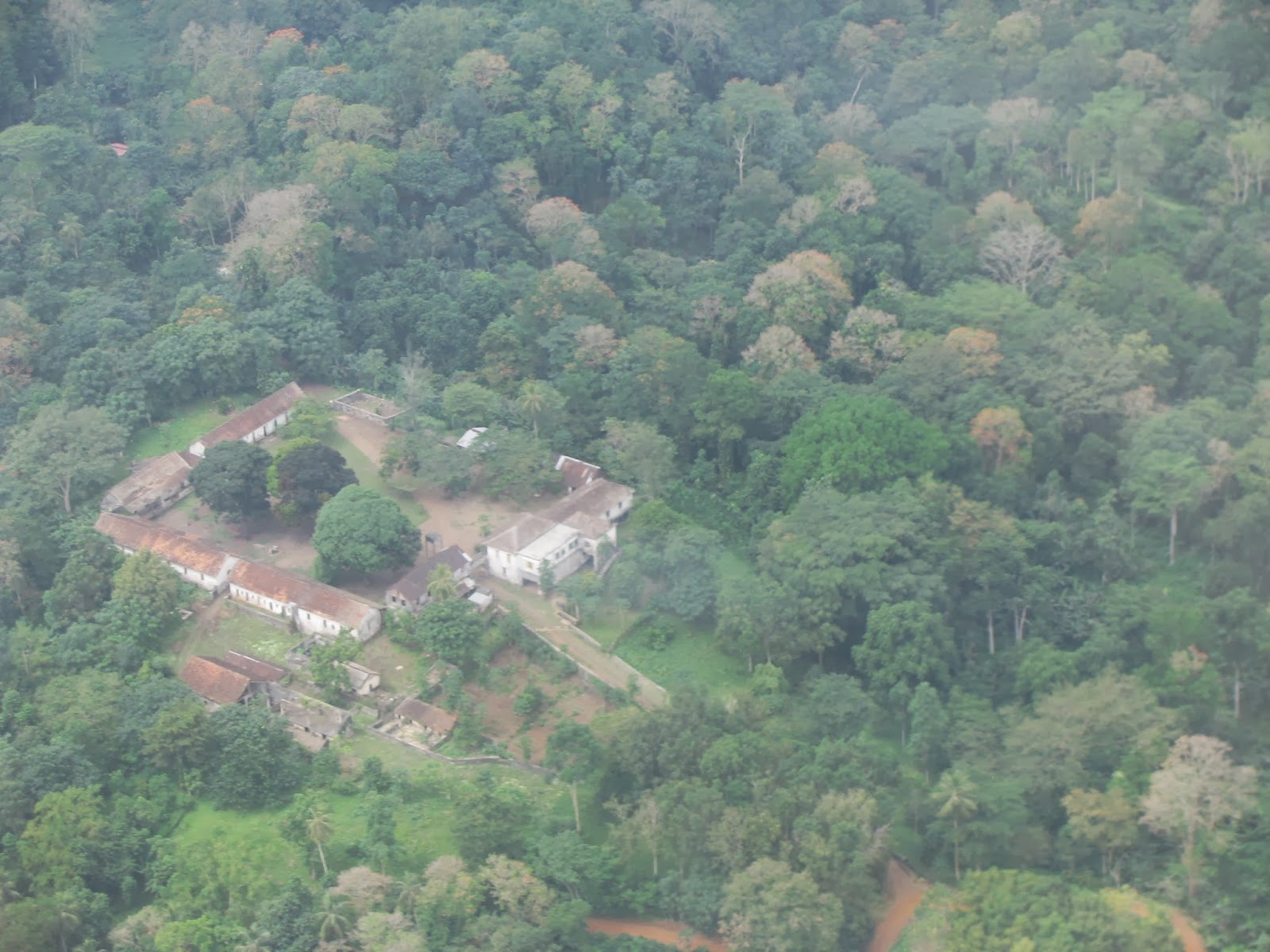
Above: cocoa farm workers and Below: present day Sundy estate with regenerating forest.
 

The Portuguese arrived in São Tomé and Príncipe around 1500. First, they, or rather the many slaves they brought to the islands, produced sugar for export. But it is the cultivation of coffee, oil palm, and especially cocoa that has done most to shape the island’s recent land use history. Large areas of land in the north of Príncipe were cleared and large plantations (roças) set up like the one at Sundy. By the beginning of the 20th century, São Tomé and Príncipe were the world’s largest producers of cocoa. These plantations, however, were broken up on Independence in 1975, and since then, forest is returning to the north of the island. There are large areas of secondary forest, rich in fruit eaten by the parrots and with much oil palm. Oil palm on Príncipe, as elsewhere in Africa, is an important food resource for grey parrots. So, the parrots feed in the food-rich north, and many nest in the primary forests of the south, an easy commute away.  This use of different habitats for different parts of their life is something found in parrots elsewhere (Marsden & Pilgrim 2003).

Principe's extensive secondary forests are good feeding grounds for parrots.
Our preliminary density estimates for grey parrots on Príncipe are 74 ± 10 per sq km in the north and 34 ± 9 per sq km in the south of the island – giving an island-wide population estimate of some 6,500 individuals. These are the highest abundance estimates for grey parrots anywhere (Marsden et al. in prep). There is evidence that the population is increasing, possibly as a function of recent reduced capture for the pet trade. In the 1990s, perhaps up to 1,500 parrots were caught on the island each year, mainly by taking chicks from nests (Juste 1996). Illegal trade still occurs but at a low level. Whether taking chicks is a somewhat ‘better’ way to harvest wild parrots than catching adults is debatable although we would expect natural mortality rates of these nestlings to be higher than older birds. In fact, one of things that we will be researching this year is rates of mortality of first year birds as compared to ‘older’ individuals. Other strands of research include examination of nesting success, and testing methods for low-cost monitoring of the population.


References

 Jones, P. and A. Tye. 2006. The birds of São Tomé & Príncipe, with Annobón, islands of the Gulf of Guinea: an annotated checklist. British Ornithologists' Union.

Juste, J. 1996. Trade in the gray parrot Psittacus erithacus on the Island of Principe (Sao Tome and Principe, Central Africa): initial assessment of the activity and its impact. Biological Conservation 76:101-104.

Marsden, S.J. & Pilgrim, J.D. 2003. Factors influencing the abundance of parrots and hornbills in disturbed and pristine forests on New Britain, PNG. Ibis 145: 45-53.

Marsden, S.J., Loqueh, E., Takuo , E.M., Hart, J.A., Abani, R., Ahon, D.B., Annorbah, N.N.D.,  Johnson, R. & Valle, S. In prep. Linking simple encounter rates to density estimates will allow monitoring of grey parrots Psittacus across Africa.

Simon Valle is funded by 


And supported by