Thursday, 25 June 2015

The history and natural history of MMU’s Ryebank Fields

One of the sites for our recent MMU Campus BioBlitzes was Ryebank Fields, a 4.6 hectare site in Chorlton, which MMU has owned for many years. Here, Stu, along with Andrew Simpson, a local historian from Chorlton, and Lynsey Crellin an environmental consultant from The Environment Partnership (TEP), talk about the site, its history, and its current biodiversity value.
Ryebank Fields: At the western border of the fields is a narrow belt of more mature woodland including large poplars and some patches of (protected) native bluebells (Photo: Chris Harrison).

History

Some of the earliest historical recognition of the area comes from the tithe map of 1845, which shows the fields as ‘Hankinson’s Reap Acre’. The area around the fields was farmed as meadow and pasture which fits with the general geography of the area. The OS map for 1933/4 again shows open land from Longford up to the Trafford Border and it appears that Ryebank Fields have never been developed.  

Extract from the Lancashire OS 6 inch 1st edition, 1841/53 map showing Ryebank fields (then Hankinson’s Reap Acre; rough position in red) in relation to the Longford estate, and Edge Lane to the South (Courtesy: Digital Archive Association).


The whole area stretching west from Oswald Road was traditionally known as ‘the Isles’ and contained many pits which had been excavated from the 17th century for marl (lime used in agriculture) and clay. By the 20th Century, some of the pits had become quite extensive, and the newspapers during the wars carried stories of children drowning, events that are still just in living memory.

Rare 19th Century photo looking out across the Isles towards Ryebank Fields and Longford Hall. The photo was taken by Aaron Booth around 1880 from his house 'Sedge Lynn' where now stands the Co-operative Undertakers in Chorlton (Photo: courtesy of Miss Booth from the Lloyd Collection).

North of Longford Brook, which bisects Ryebank Fields, was a large clay pit with another pit to the South. Judging from the tramway marked on the 1930s OS map, this must have been worked as part of the brickworks which was in operation from the beginning of the 20th century until it closed in the 1950s.

Original Ordnance Survey Revisions of 1932-1935 showing WW2 bomb damage 1940-1 (red circles = fire bombs; blue circles = high explosives). Shown are Ryebank Fields dominated by claypits, along with the brickworks (A) on what is now St John’s Primary School, and the tramway (B) linking the two. The cottages on Cardiff Road are also marked (C) – these houses and indeed the road itself did a complete disappearing act in the 1970s (see Andrew's blog here).
Sometime after closure, the pits were filled, probably with rubble, and capped with top soil. You can see the differences in vegetation between the centre of the ‘south field’ and its edges in aerial photos of the site. Ryebank Road Playing Fields, to give them their official name, were used as a sports facility by MMU until 1996. 


Aerial view of Ryebank Fields


Natural History

The mosaic of habitats across the site provide a valuable resource for urban wildlife. For example, the recent BioBlitz recorded 64 species of plant on the site. The fields are dominated by modified neutral grassland, with areas of ‘plantation’ woodland, scrub and tall ruderal herb, predominantly around the margins. Certain areas of grassland displayed marshy, or acid tendencies, reflecting the diverse history of land use.
 

The grasslands of Ryebank include some marshier areas with associated great willowherb Epilobium hirsutum, hairy sedge Carex hirta, jointed rush Juncus articulatus, and hard rush Juncus inflexus (Photo: Chris Harrison)


Much of the site’s small woodland areas are surrounded by housing and contain a number of plant species which have escaped from residential gardens, including variegated yellow archangel (an invasive species listed on Schedule 9 of the Wildlife and Countryside Act 1981, as amended, in England and Wales). More interesting is the woodland on the fields’ Western border, where there are small stands of protected native bluebell, a possible relic from historic ancient woodlands on the site. Three mature trees have potential for roosting bats (Category 1 in accordance with Bat Conservation Trust Guidelines) and the network of habitats (woodland, grassland, scrub and tall ruderal herb) provide high quality foraging opportunities for bat species. A suspected fox earth was found on the site. Around 30 bird species have been found using the fields this Spring, including Whitethroat holding territory, and perhaps 3-4 pairs each of Blackcap and Chiffchaff. Tawny Owl is regular here and in adjacent Longford Park.


Common Malachite Beetle Malachius bipustulatus on Buttercup at Ryebank (Photo: Chris Harrison).

There is potential for improving the biodiversity value of the fields. David Bishop, local botanist from Friends of Chorlton Meadows, suggested that taking out a hay crop in the late summer might be a good management, to reduce the fertility of the soil and in turn to promote a ‘healthier’ grassland plant community. There were also suggestions from TEP that a scrape or pond would be beneficial (smooth newts have been recorded in adjacent Longford Park) as there is little standing permanent water in this part of Chorlton. Even more intriguing is the possibility to create some ‘broken ground’ with rocks etc to form habitat for Common Lizard, a species of real conservation concern in UK.

Acknowledgements

The MMU BioBlitz at Cheshire Campus was funded by MMU Environment team in Estates Department 


and carried out in collaboration with 


Image result for tep the environment partnership

Wednesday, 18 February 2015

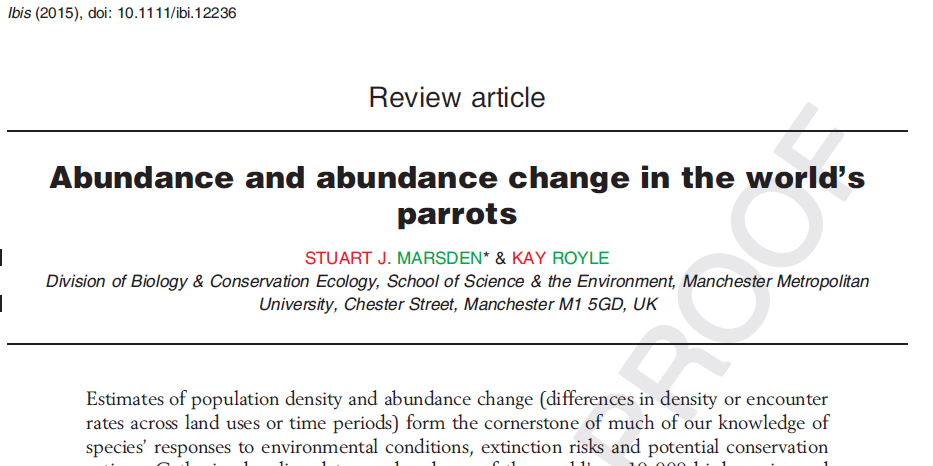
Abundance and abundance change in the World's parrot


Posted by Stuart Marsden & Kay Royle

A review paper, to appear in the April issue of Ibis examines natural abundance in the world’s 350 or so species of parrot, and how this abundance changes in human-altered habitats. 


The review was started several years ago when Kay was a second year undergraduate student at MMU. Helping lecturers with their research is an excellent way for students to get involved in science and publish papers while still studying – it is also good for us lecturers as it is a good opportunity to get someone to do the donkey work, for which we do not really have the time. Kay is currently finishing her Masters project on vocalisations in Sylvia warblers with Selvino de Kort at MMU.

Mixed flush at Peruvian Colpa (Photo: Alan Lee)

The aims of the review were threefold

1. To gauge how much data there are on abundance in the world’s parrots, what methods have been used in their study, and where the main gaps in knowledge are.

2. To identify if there are commonalities in abundance across parrot species – are related species likely to be similarly common?

3. To look for generalities in abundance changes when primary forest is converted to other land uses such as plantations, and small-scale agriculture.  


Little Corellas in Queensland (Photo: Stu)

A major job was finding publications and reports containing suitable data – this was done through exhaustive searches on Web of Knowledge and other on-line databases. Particularly useful was the Parrot Literature library of the newly formed Parrot Researchers Group initiated by Juan Masello. In all, we found 74 papers/reports containing abundance estimates. 


Plum-headed Parakeet (Photo: Paul Donald)

Density estimates were found for just 25% of 355 parrot species. This is a frighteningly small proportion, especially when one considers that parrots are among the better known groups of birds in the world. Even more alarming is that Threatened species were no more likely to have a density estimate than non-threatened species, and were less likely to have estimates of abundance change.
The methods of choice for abundance estimation in parrots is distance sampling, either from point counts or line transects (84% of all estimates) while spot-mapping accounted for around 8% of estimates.

The wonderful Palm Cockatoo (Photo: Peter Odekerken)

There was a ‘phylogenetic signature’ on parrot abundance – in other words, species within the same genus do tend to have more similar densities than other less-related species. Very importantly, parrot abundances are generally higher within protected areas than outside them - it is unclear whether the latter effect stems from habitat protection, a reduction in poaching or both, but protected areas appear to be beneficial for parrots.

Chestnut-fronted Macaws (Photo: Alan Lee)
Responses of parrots to habitat change were highly variable, with natural variation in parrot abundance across different primary forests as great as that between primary forest and human-altered forests. Conversion of forests to monocultural plantations like oil palm and Eucalyptus are almost certainly bad for parrots, but parrots often actually become commoner as forest is converted to small-scale agriculture.

Timneh Parrots (Photo: Nat Annorbah)
The speed at which environmental change is affecting the world’s parrots far outstrips that of our current capacity to track their abundance and we assess the likely scale of data deficiency in this and other bird groups. For example,For example, Scarlet Macaw Ara macao has an extent of occurrence well in excess of 5 million sq km and has just four density estimates from a single study. In the paper, we discuss developments in survey methods such as distance sampling, occupancy modelling and species distribution modelling which may help us bridge this data gap.

You can read an accepted version of the paper here.

Monday, 9 February 2015

The faces and races of Yellow-crested Cockatoo

Posted by Stuart Marsden & Nigel Collar
 
A paper recently published in the OBC journal Forktail looks again at variability across populations of the Critically Endangered Yellow-crested Cockatoo Cacatua sulphurea of Indonesia and East Timor. Our aim was to identify characteristics of the different subspecies which can help captive breeders maintain genetic integrity of breeding stock and to help authorities to identify the origin of smuggled birds.


Modern taxonomic treatments recognise four subspecies of the cockatoo: sulphurea from Sulawesi and associated islands, abbotti on Masalembu Besar, parvula from Lombok to Timor, and citrinocristata on Sumba. All of these subspecies are extremely rare – abbotti numbers just a handful on a tiny island in the Java Sea. Perhaps the strongest population is of the distinctive citron-crested population on Sumba (one of the foci of Stu's own PhD many years ago). 


Cacatua sulphurea parvula on Komodo island, Indonesia (Photo: James Eaton/Birdtour Asia)

We compared morphometric data (lengths of upper mandible, wing, tail and crest; colour and size of ear-covert patch) from 136 sexed museum specimens from across the range of the species. Specimens were examined, mainly by Nigel, at American Museum of Natural History, Natural History Museum, Tring, UK, Naturalis at Leiden, Staatliches Museum für Tierkunde, Dresden, National Museum of Natural History, Washington DC, USA (USNM); Zoologisches Museum, Berlin, and Academy of Natural Sciences of Philadelphia. 


Specimens (all female except that from Sumba, for which sex unknown) representing five taxa of Cacatua sulphurea, left to right: citrinocristata; parvula; occidentalis; djampeana; and sulphurea (Photo: Nigel Collar)

There were clear differences among subspecies and also between the sexes in wing, tail and bill lengths. Ear covert patch size also differed. The races abbotti and citrinocristata were particularly distinctive and would be easy to identify in captivity. Biometric differences were quite complex: wing length differed across both taxon and sex; tail length differed across taxon but not sex; and the main differences in mandible size were across sex rather than taxon (with the otherwise ‘average’ sulphurea having a particularly large bill). Analysis of body structure also revealed important differences – with abbotti, parvula and citrinocristata having long wings and short tails, and the other species having short wings and long tails. There were also differences in ear-covert colour and size.


The distinctive citrinocristata race from Sumba island, Indonesia (Photo: James Eaton/Birdtour Asia)
Our analyses result in the reinstatement of the subspecies occidentalis (Lombok to Alor, leaving parvula confined to Timor) and djampeana (Tanahjampea Islands). We formally recognise a new subspecies of C. sulphurea - paulandrewi subsp. nov. from the Tukangbesi Islands. This new subspecies is named after Paul Andrew, an old friend of Nigel’s who helped write the first ‘Birds to Watch’ back in the 1980s.


Males of three geographically adjacent taxa of Cacatua sulphurea: top C. s. sulphurea; middle C. s. djampeana; bottom C. s. paulandrewi type specimen (Photo: Nigel Collar)

Under the taxonomic scoring system Nigel helped develop, the distinctive race citrinocristata from Sumba comes very close to species status, but not quite. Further evidence on behaviour and juvenile colouration may clinch this in the future.


Distribution of the subspecies of Yellow-crested Cockatoo Cacatua sulphurea in Wallacea and adjacent islands. Included is the new taxon, paulandrewsi on the Tukangbesi Islands.

There may be uncertainty about the specific status of citrinocristata, but there is little doubt that the species as a whole is in serious trouble right across its range. There are recent reports of declines on Komodo, a once large and well-protected population, while the Sumba population apparently remains low despite years of protection. We have a new project to resurvey populations of citrinocristata on Sumba and the species on Komodo. More on this project soon.