Friday, 27 June 2014

Amphibian declines in Bale, Ethiopia

Posted by Michele Menegon

The creation of a new road in the Bale Mountains, Ethiopia, in the 1980s gave herpetologists a rare opportunity to study amphibians in the area. Michele, a PhD student in the research group, was part of a team which recently repeated Amphibian surveys first done in 1986. The team found some potentially very serious declines in amphibians from the area. Results have recently been published in the journal Oryx.


The Bale Mountains

The Bale Mountains lie in southern Ethiopia, east of the Rift Valley. The Mountains rise to nearly 4,400 m, and the extensive massif has a rich flora and fauna, including many unique, rare, spectacular and threatened taxa. Hillman (1986) considered the Mountains ‘a centre of faunal endemicity, probably with the highest rate of animal endemicity for a terrestrial habitat anywhere in the world’.

Ethiopian wolf (Canis simensis) one of the many endemics of the Bale Mountains (Photo: Paul Donald)


The highest part of the region, the Sanetti Plateau and associated peaks, comprises Afroalpine grasslands but to the south is the Harenna escarpment that drops from 3,200 to 2,000 m in just 8 km. A substantial area (c. 2,200 sq km) of the region is covered by the Bale Mountains National Park, established in 1971 but not yet formally gazetted by the Ethiopian government.


Forest alteration in Harenna Forest (Photo: M. Menegon)


Bale’s frogs and toads

Despite a long history of human habitation in the area, the Bale Mountains remained largely unexplored scientifically until the middle of the 20th century. W.H. Osgood, from the Chicago Field Museum,  collected some amphibians and reptiles in 1926–1927, and M.J. Largen and colleagues carried out extensive collections between 1971 and 1975. Early collecting expeditions were centred around Dinshu and the northern slopes below the Sanetti Plateau.

Around 15 amphibian species (all anurans) have been reported from the Bale Mountains, including 10 endemics (Largen, 2001; Largen & Spawls, 2010). The Bale Mountains National Park is an ‘Alliance for Zero Extinction’ site (http://www.zeroextinction.org), partly because of its threatened amphibians (Alliance for Zero Extinction, 2010). Given the Park’s importance for their conservation, we focus here on four monotypic frog genera: all endemic to Ethiopia and three endemic to the Bale Mountains.


Bale mountains moss frog (Balebreviceps hillmani)  (Photo: M. Menegon)

The survey and re-survey

In 1983, when a new road was constructed through the forest, it became possible to reach the Harenna Forest, on the southern side of the massif. Conscious of the conservation threat posed by the new road, the Ethiopian Wildlife Conservation Organization arranged an expedition with Addis Ababa University to conduct a preliminary survey of the Harenna Forest in August 1986. During a meeting in London a few years ago, Dr. Largen said that all the species discovered during the 1986 expedition were abundant, or very abundant, and that they often were seen, directly from the car, moving around the vegetation right by the side of the road.

In 2009, I was part of a team of five researchers, David Gower from the NHML, U.K. Simon Loader and Abebe Mengistu from University of Basel, Switzerland, and Rafael de Sa from University of Richmond, U.S.A. We spent around one month surveying frogs both in Bale Mountains and some of the western forests around the town of Bonga. This survey gave us the opportunity to re-survey frogs in the areas first surveyed in 1986. At that time, frogs were easy to find along the newly cut road – the surveyors could simply stop their car and collect many species of frogs right by the side of the road.


Altiphrynoides malcolmi:  a genus endemic to Bale Mountains (Photo: M. Menegon)

The results of our re-survey are presented in an Oryx paper. We present long-term quantitative data (individuals encountered per person hour of searching) for four monotypic frog genera endemic to an Afromontane region of exceptional importance, but growing conservation concern. These include one endemic to the Ethiopian highlands Altiphrynoides osgoodi and three endemic to the Bale Mountains: Altiphrynoides malcolmi; Balebreviceps hillmani; and Ericabatrachus baleensis; all collected during 15 field trips to the Bale Mountains between 1971 and 2009.

Only a single confirmed sighting of S. osgoodi has been made since 1995. The other three species have also declined, at least locally. E. baleensis appears to have been extirpated at its type locality and at the same site B. hillmani has declined. These declines may be associated with substantial habitat degradation caused by a growing local human population. Chytrid fungus was also found on several frog species in Bale, although no dead or moribund frogs have yet been encountered. These results mean there is an urgent need for more amphibian surveys in the Bale Mountains. Additionally, we argue that detrimental human exploitation must be halted immediately in at least some parts of the Harenna Forest if a local, and hence global, conservation crisis is to be averted.


Balebreviceps hillmani  (Photo: M. Menegon)


References

Alliance for Zero Extinction (2010) 2010 AZE Update. http://www.zeroextinction.org 

Gower, D.J., Aberra, R.K., Schwaller, S., Largen, M.J., Collen, B., Spawls, S., Menegon, M.,
Zimkus, B.M., De Sá, R., Mengistu, A., Gebresenbeta, F., Moore, R.D., Saber, S.A.  and Loader, S.P. (2013) Long-term data for endemic frog genera reveal potential conservation crisis in the Bale Mountains. Ethiopia. Oryx 47(1):56–59

Hillman, J. (1986) Bale Mountains National Park. Management Plan. Ethiopian Wildlife Conservation Organization, Addis Ababa, Ethiopia.

Largen, M.J. (2001) Catalogue of the amphibians of Ethiopia, including a key for their identification.Tropical Zoology, 14:307–402.

Largen, M.J. & Spawls, L. (2010) The Amphibians and Reptiles of Ethiopia and Eritrea. Chimaira, Frankfurt Am Main, Germany.

Saturday, 7 June 2014

Has Worthen's Sparrow had its chips?

Posted by Irene Ruvalcaba Ortega, Ricardo Canales, José I. González and Stuart Marsden

Stu has recently been in Mexico working with research groups from three universities along with a team from Pronatura (the BirdLife partner) on research into some of the country’s most threatened birds. These included the northern population of the Sierra Madre Sparrow Xenospiza baileyi, the Baja endemic Belding’s Yellowthroat Geothlypis beldingi and the pine-loving Thick-billed Parrot Rhynchopsitta pachyrhyncha (all Endangered).


But first up was the Worthen’s Sparrow Spizella wortheni, a charming but Endangered bird of the shrub-grasslands of the northern states of Coahuila and Nuevo León. A major threat to the sparrow is the expansion of potato-growing in the region. Here, Irene Ruvalcaba Ortega, Ricardo Canales, and José I. González from Laboratorio de Biología de la Conservación y Desarrollo Sustentables (UANL) and I talk about the conservation biology of the species, and a project that we hope to initiate that will help secure its near future. 


The Endangered Mexican endemic Worthen's Sparrow Spizella wortheni (Photo: Ricardo Canales)

Worthen’s sparrow, a relative of the semi-migratory Field Sparrow Spizella pusilla, was first described from New Mexico, USA, in the 1880s – this remains the only record of Worthen’s from outside ‘old’ Mexico. The last 100 years or so has seen its range contract so much that it known now from just a few sites in two of Mexico’s northern states. BirdLife’s assessment is that there may be as few as 100 mature individuals - although they point out that there is scope to find new populations in this vast landscape.

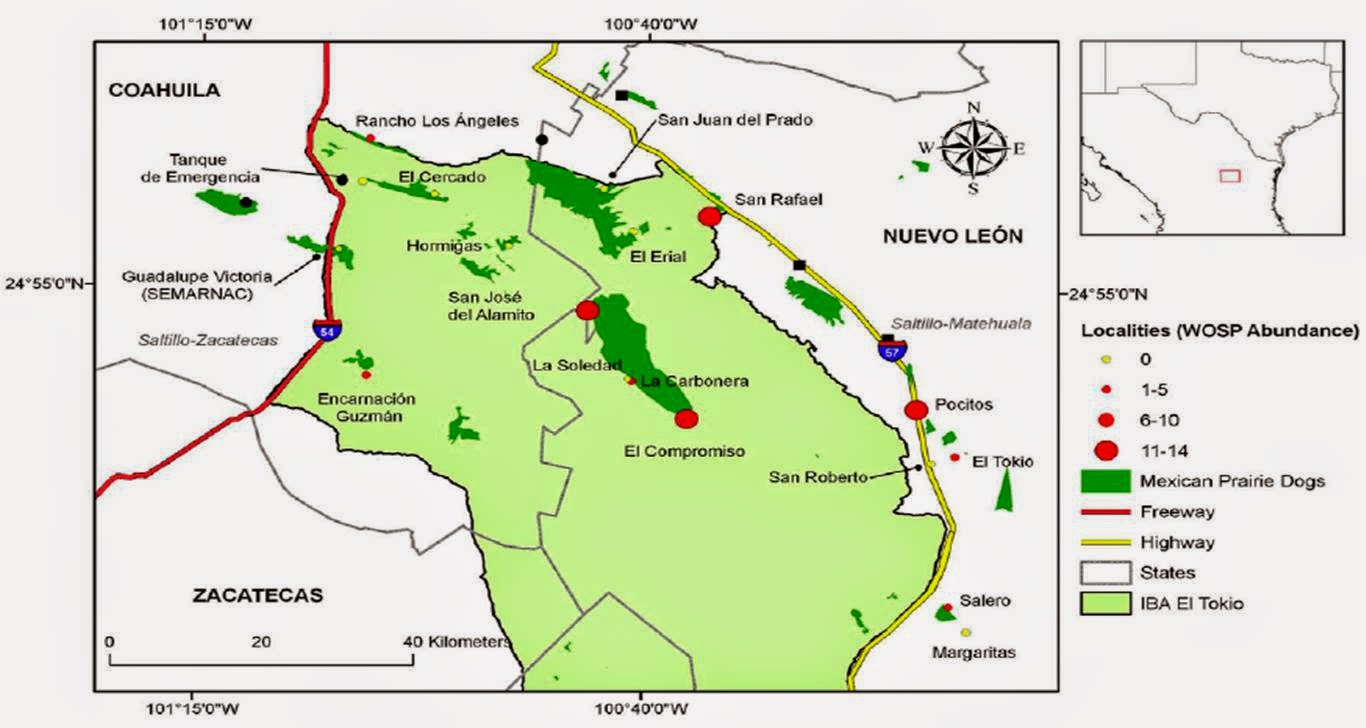
Following discussions at the Universidad Autonóma de Nuevo Leon, where much of the recent research on the species has been carried out, we headed out into the field, joined by Hugo Elizondo, a research assistant who has seen more Worthen’s in the wild than anyone. Work by the group has found several new sites for the species and important new breeding areas (Canales-del Castillo et al. 2010). There may be more undiscovered populations – some areas cannot be visited due to security problems associated with Mexico’s cartels.


The main areas where Worthen's Sparrow are known to occur. New sites are being found, but search efforts are hampered by security issues.
The main habitat of the sparrow is centred around large flat basins, very shallow valleys surrounded by higher ground with Juniper bushes holding Bushtits, and Black-chinned and Black-throated Sparrows. On the flat ground are extensive colonies of the Endangered Mexican Prairie Dog Cynomys mexicanus. Also eating grass are cows, sheep, Black-tailed Jackrabbit and Eastern Cottontails. This is one of those landscapes where everywhere looks the same or every hectare of it looks different – depending on how closely you look. Reconstructing the history of human use of these areas, and identifying the main natural and anthropogenic gradients within the area may be one of the keys to understanding the sparrow’s past, present and future. 

Worthen's sparrow in typical nesting habitat (Photo: Ricardo Canales)
We visited some areas of grassland which are used by flocks of Worthen’s in the non-breeding season. They are nomadic and seem to appear in different areas in different years – this may serve them well as the landscape is constantly changing (e.g. Canales-Delgadillo et al. 2012). Areas are ploughed for growing potatoes, some areas we visited were lush after the rain, others inexplicably dry. Next, we saw 10-15 breeding pairs in a small area of great habitat in La Soledad. Nests were relatively easy to locate, placed 5-30 cm above the ground in the centre of Tarbushes Flourensia cernua and Creosotebushes Larrea tridentata, sometimes with Opuntia sp. Research by UANL suggests that nesting success can be low, perhaps due to predation by snakes, birds etc – intensive study of the factors which affect recruitment should clearly be a key component of further study.
Worthen's nesting habitat at Museo de las Aves de Mexico's La India reserve (Photo: Stu)
Over the two days, we also visited some small reserves, and an area of abandoned crops, which still held a pair of sparrows in a tiny remnant patch of habitat. A collaborator on our planned project will be Museo de las Aves de Mexico www.museodelasaves.org, a museum in the historical city of Saltillo, dedicated to birds. We visited their extensive protected area and research site at La India, where several pairs of Worthen’s were found breeding in a bush-grassland habitat subtly different from that in La Soledad. A comparison of ecology and breeding success in the two differently managed areas would be invaluable.
 

Our immediate aim is to get a Mexican PhD student, supported by Masters and Undergraduate students working on Worthen’s and its habitat.


References

Canales-Delgadillo, J.C., Scott-Morales, L. & Korb, J. (2012). The influence of habitat fragmentation on genetic diversity of a rare bird species that commonly faces environmental fluctuations. Journal of Avian Biology 43: 168-176.


Canales-del Castillo, R., Gonzalez-Rojas, J.I., Ruvalcaba-Ortega, I. & Garcia-Ramirez, A. (2010). New breeding localities of Worthen's Sparrows in northeastern Mexico. Journal of Field Ornithology 81: 5-12.

Tuesday, 20 May 2014

A dietary check-up for parrots in the western Amazon

Posted by Alan Lee


In a recently published paper, Alan, Stu and others report on an intensive study of the diets of a range of parrots in Peru. Dietary data of this sort are rare – seldom are the resources/person-power available to accumulate the data, and studying diets is not always seen as a fashionable way to go about ecology. Here, Alan talks about the study, its making, and its findings.


Parrots have good manners – they don't tend to speak with their mouths full. That makes them a bit hard to find when foraging quietly in the upper canopy. Luckily, they are messy eaters, and fruit fall invariably leads the observer to something frugivorous, be it a Red-howler monkey (Alouatta seniculus), Spix's Guan (Penelope jacquacu), Curl-crested Aracari (Pteroglossus beauharnaesii) or one of the 20 odd species of parrot – if you happen to be looking for them in the lowland Amazon rainforests of Peru. Together with people from all walks of life, I registered birds eating food for over two years, amassing a data set of over 1500 encounters with foraging parrots. 

Aldo, Philip, and Percy test what the macaws have been eating (Photo A. Lee)

One of the first things we noticed was that these birds prefer to forage from the same individual trees – usually amongst the largest tree (adults, and at least at canopy level). For the sake of independent samples, many of these repeat encounters needed to be omitted – but they accounted for over 10% of all encounters. We would place foraging tape on trees marked when a foraging encounter had been recorded, and soon some of the more frequently walked trails were decorated with registrations. 

A foraging event, the left over breakfast: macaws cracked open and at the seeds from this noxious vine (Photo A. Lee)

To account for the fact that we may be missing birds foraging on smaller items, like small fruit and flowers, we also watched birds from canopy towers, as well as when floating down the river by boat to town from our study sites along the Tambopata River. Rather unsurprisingly given the difference in sizes of the parrots involved, we found that different parrots fed on different plant species and reproductive parts. For example, while all parrots fed on Brazil nut trees, large macaws with their powerful beaks went for the developing seed pods, while the smaller parrots fed on the flowers. All parrots loved the fruits and seeds of the Wasai palm.


While the colourful or endangered macaws
are most frequently photographed at
claylicks, its the little and common
Dusky-headed parakeets that
visit in greatest numbers.

(Photo A. Lee)


One of the main reasons we were recording foraging events was to document what plant parts were being consumed (e.g. fruit pulp or seeds) and whether the fruit were ripe or unripe. We were expecting that our records of surveys of the geophagy sites in the area (claylicks where birds would eat soil) should indicate those birds that eat more seeds and unripe food items should be those that eat more soil, if the theory held that the clay binds dietary toxins. This is because unripe fruit and seeds tend to have higher quantities of tannins and other things that make the unripe fruit taste unpleasant – at least to us. This is because the plants don't want to have their reproductive bits eaten after all.


Red-and-Green Macaws at a claylick
on the Los Amigos River (Photo A. Lee)


In addition to the fun task of watching parrots feasting, we also undertook the more onerous task of recording the fruiting status of 1800 individually marked trees every month. We did this to understand phenology patterns – to identify if there were any periods with little food availability that could perhaps drive the parrots to consume soil in the absence of food. Although there was a clear pattern of peak flowering and fruiting seasons, there was something fruiting of flowering throughout the year, especially if we concentrated only on the plant species the parrots preferred to forage on. So there is no evidence that these parrots eat soil due to bottlenecks in food availability.


We had previously worked out bird densities for the region by conducting line transects at multiple sites in the area (http://onlinelibrary.wiley.com/doi/10.1111/j.1744-7429.2011.00847.x/abstract), so we could calculate an estimate for the population of birds that were in the vicinity of a claylick i.e. the audience. What we found when we divided upper estimates of the numbers of birds feeding on the clay by the local population, was that the macaws – the parrots most famous for eating seeds and unripe fruit items – in fact did not consume more clay than expected. Surprisingly, it was the parakeets associated with secondary forests – Dusky-headed (Aratinga weddellii) and White-eyed parakeets (Psittacara leucophthalma) – that were represented on the claylicks more than expected. 


In the popular literature claylicks are associated with, and illustrated by, the large and colorful members of the parrot family - the macaws (Photo A. Lee)


Furthermore, our foraging encounters also suggested that these birds ate more flowers – specifically balsa flowers (Ochroma pyramidale) – than seeds. In addition, those species that were associated with terra-firme forests (White-bellied parrots Pionites leucogaster and Orange-cheeked parrots Pyrilia barrabandi) were observed less frequently on claylicks. 
Most publications investigating patterns of clay consumption or reasons for clay consumption from the Peruvian Amazon have concluded that they do it for the sodium. Our dietary study at least does not support the alternative hypothesis – that they do it to counter dietary toxins. 

The research has been funded by:


Friday, 2 May 2014

Our Sangihe and Talaud project takes off

Posted by Stuart Marsden and Hanom Bashari

First, I’m delighted to say that the Rainforest Trust and Loro Parque Fundacion have agreed to fund our project on Sangihe and Talaud. The project will be undertaken in partnership with Burung, the Indonesian BirdLife partner. The bulk of the work will be done by Rob Martin (currently at BirdLife in Cambridge), who will start an MPhil/PhD here at MMU in July, under the supervision of Stu, Elias Symeonakis (MMU), and Nigel Collar of BirdLife. Working alongside Rob will be Hanom Bashari of Burung. 


Above - The Sangihe endemic and Endangered Elegant Sunbird Aethopyga duyvenbodei (Photo: Hanom Bashari). Below - Nutmeg, which along with Cloves are a major source of income for the people of Sangihe and a major impact on the forest (Photo: Stu)

Stu has recently returned from a trip to Sangihe and Talaud, where I was accompanied and looked after by Hanom. We first spent some time at Burung’s headquarters in Bogor discussing the project with Agus Budi Utomo, Burung’s chief and Ria Saryanthi. I had the opportunity to give a presentation to Burung staff and local graduates about our work at MMU, and particularly our research on tropical frugivores inside and outside of protected areas.


Above - Another Sangihe endemic, the Sangihe Kingfisher (Photo: Hanom Bashari). Below - Forest gardens on Sangihe. It could be that with a bit of tweaking, some of these habitats might be important for some of the endemics (Photo: Stu)

It seemed to take an age to get to the forest on Sangihe. The terrain is incredibly steep – that is partly why forest remains there when it has given way to clove, nutmeg and coconut plantations elsewhere on the island. We started searching for the Cerulean Paradise Flycatcher at Mount Awu – in forest which was heavily degraded. We didn’t find the bird but there were 1-2 valleys which contained habitat that might be ‘nearly good enough’ for the species. In fact, this seems to be a possible theme for our research….how can small changes to the way people use the forest yield significant increases in an area’s suitability for birds? It may be that creating buffers of lesser-used habitat around streams might be a potential way forward.


Above - Cerulean Paradise-flycatcher Eutrichomyias rowleyi and Below Sangihe Shrike-thrush Colluricincla sanghirensis both Critically Endangered (Photos: Hanom Bashari)

Our main recce was at Sahendaruman, where we did see the flycatcher in incredibly steep valleys. There aren’t many birds in these forests – particularly, a lack of monarchs, fantails, white-eyes etc means that mixed species flocks do not seem to develop. A clamber up the steep valley sides took us to the ridge tops – where the interesting-looking Sangihe Shrike-thrush was seen, but no Bulbul and definitely no white-eye.


Ridge forest on Sangihe (Photo: Stu)
Then on to Talaud. This is a very different island, relatively low-lying and ‘non-volcanic’. I has a nice almost  ‘Caribbean-like feel to it. We didn’t have time to get to the primary forests in the island’s interior, where there may be lots of birds and maybe new discoveries to be made, but the garden-type habitats and forest fragments we did visit were birdy. Talaud Rail, Talaud Kingfisher and the ‘new’ pitta were seen, although the only bushhens I saw were five Rufous-tailed Waterhen Amaurornis moluccana. Parrots, including the ‘Sampiri’ (Red-and-blue Lory Eos histrio) were reasonably common and we saw at least two of the Tanygnathus and the racquet-tail Prioniturus platurus.

The endemic and Near-threatened Talaud Kingfisher Todiramphus enigma (Photo: Hanom Bashari)

We visited a Sampiri roost and interestingly, we got the chance to talk to Pak Zaka, a very nice and very knowledgeable parrot trapper-turned-conservationist. My first question was “Are lories rarer now than they were 20 years ago? (when he worked with Jon Riley and Jim Wardill of ‘Action Sampiri’). His answer was quite surprising and incisive. “It is odd…that 20 years ago there were lots of parrot trappers, and year after year there were lot of lories. Now, at a time when there are few trappers, there are few lories. The reason? There are so many chainsaws….people cutting down the big trees that the lories need for nesting. The lories have gone into the big forest in the interior”. 

Red-and-blue Lories Eos histrio - Endangered (Photo: Hanom Bashari)

Finally, I got to visit WCS’s Maleo project in NE Sulawesi and even got to release two baby Maleos. A couple of days searching for Sulawesi endemics at Mount Mahawu and Dumoga Bone NP yielded Scaly-breasted Kingfisher, Rufous-throated Flycatcher, Maroon-chinned fruit dove, some nice owls, Blue-eyed Rail, and several other Wallacean treats.


The Sangihe Hanging-parrot Loriculus catamene is Near-threatened (Photo: Hanom Bashari)

A big thanks to all those kind folk we met along the way. 


Our project on Sangihe and Talaud is sponsored by


Tuesday, 22 April 2014

Counting Andean Condors at feeding stations

Posted by Diego Mendez and Huw Lloyd

Conservation Biology Masters student Diego Mendez has been awarded a research grant from the Peregrine Fund for his proposed MSc thesis research entitled ‘Designing a standardised photographic mark-recapture method for estimating population densities of Andean Condor using feeding stations’. Diego, a graduate of the Universidad Mayor de San Simón, Cochabamba, Bolivia, has been studying Andean Condors in Bolivia with Birdlife International partner organisation Armonia since 2012. He has been studying at MMU since September 2013 and will be undertaking his fieldwork in June 2014 with supervision from Dr Huw Lloyd and Dr Stuart Marsden.


Diego photographing Condors
Andean Condor populations are declining throughout their range due largely to human persecution and reduced food availability. Globally, the species is listed as Near-threatened, but in Bolivia, the species is listed as Vulnerable. The species is notoriously difficult to survey due to its preference for the rugged topography of Andean habitats and the large distances individuals are able to travel each day. This has resulted in a lack of population data for the species. Recent studies from the Apolobamba Mountains in NW Bolivia have used feeding stations to attract and photograph individual condors (Ríos-Uzeda & Wallace 2007). This has proven to be a successful survey technique whilst also providing data on Andean Condor population structure.

Above - Andean Condor is currently listed as 'Near-threatened; Below - typical Condor habitat (Photos: Diego Mendez)

Natural markings on Andean Condors will enable Diego to reliably identify birds in different sex and age categories. Adult males are easily distinguishable from females by their crests and black eyes which females lack. Adult condors differ from sub-adults in having conspicuous white secondary feathers, and juveniles are brown in colour, with no white secondary or neck feathers. Adult males are also recognisable from each other based on differences in the shape and size of their crests, and the wattle-like skin-folds.


Above - Adult male Andean Condor, and Below - females (Photos: Diego Mendez)


Using photographs from the feeding stations in a ‘mark-recapture’ analysis has potential to be a useful survey technique for the species throughout Bolivia and neighbouring Andean countries. With additional funding from the British Ornithologists' Union and the Neotropical Bird Club, Diego plans to expand on this earlier study by creating feeding stations at over 30 different feeding station locations sited at standardised distances (25, 50 and 100 km) from each other throughout the eastern Bolivian Andes. Photographs will be be taken from a hide constructed at each feeding station from 07h00 to 18h00 for periods of five days. This will enable Diego to obtain reliable estimates of density and accurate observations of condors, and comparisons of re-sighting probabilities of photographed Andean Condors at different distances. As a result, Diego’s research may also help key areas for the conservation of the Andean Condor population in Bolivia.


Adult males are individually recognisable through careful examination of the shape and size of their crests, and the wattle-like skin-folds (Photo: Diego Mendez).  

References


Ríos-Uzeda, B. and R.B. Wallace. 2007. Estimating the size of the Andean Condor population in the Apolobamba Mountains of Bolivia. J. Field Ornithol. 78:170-175

Diego’s Masters project will be done in conjunction with Armonia and is funded by the Peregrine Fund, British Ornithologists Union and Neotropical Bird Club.


Wednesday, 16 April 2014

The hunt for Philippine Ducks

Posted by Beth Roberts and Carmela Española

Beth has just returned from Philippines where she attended the Wildlife Conservation Society of the Philippines conference, and, together with Carmela Española, started a project looking at distribution, abundance and hopes for the little-studied Philippine Duck.


Conversion of wetlands to agriculture is placing many species under increasing threat of extinction (Photo: Beth Roberts)
The Philippines is among 25 megadiversity hotspots in the world and has been placed within the two ‘hottest of hotspots’ owing to its high levels of endemism (>47% of vertebrates and >76% plants). However, this rich biodiversity do not translate into increased measures of conservation action, and 33% of the country’s 181 endemic birds are threatened, the second highest total of any country. One such species is the threatened Philippine Duck Anas luzonica. My PhD research to date examines the biases in published wildfowl demographic research (see http://stuartmarsden.blogspot.co.uk/2014/01/macro-demography-and-conservation-of_18.html) and highlights the importance of conducting studies in areas with limited knowledge, such as the Philippines.

Philippine Duck Anas luzonica (Photo: Arman Asilo)

To gather vital basic ecological and habitat requirements of the Philippine Duck, I visited the Philippines with funding received from two MMU awards (Careers and Development award and an RKE Conference award). Dr Carmela Española and I visited four wetland habitats, two of which are Ramsar sites. Hunting continues at all sites; however, at the Ramsar sites, prosecutions for Philippine Duck hunting had been made.

Candaba Bird Sanctuary (Photo: Beth Roberts)

We first visited Candaba Marsh, Luzon (categorised as an IBA); an important wetland site for resident waterbirds and migratory species with recorded sightings of Baer’s Pochard Aythya baeri (Critically Endangered) and Streaked Reed-warbler Acrocephalus sorghophilus (Endangered). Candaba Bird Sanctuary, a 100-hectare private property of the former mayor Jerry Pelayo, acts as a wetland fragment in an agricultural landscape and is under threat from agriculture expansion.

Other species, such as Clamorous Reed-warbler Acrocephalus stentoreus
are found in the wetland habitats (Photo: Beth Roberts)
Large numbers of Wandering Whistling-duck Dendrocygna arcuata and Philippine Duck were present, along with many other wetland bird species. We recorded over 300 Philippine Ducks at the site and, whilst interviewing local farmers, we observed a man standing on a water buffalo collecting eggs, possibly Philippine Duck eggs.

Man stood on a carabou collecting birds’ eggs in the marsh (Photo: Beth Roberts)

The ducks were flushed from the disturbance (Photo: Beth Roberts)
We also conducted a site visit to the river mouth at Subic Bay, Luzon, which has historically recorded 400 Philippine Ducks congregating in a large group in the mangroves. We found no ducks, but we gathered valuable nesting and habitat data from local people.

The mangrove area at Subic Bay (Photo: Beth Roberts).
Our third site was Naujan Lake (14,568 ha) in Mindoro, designated a Ramsar site, and the fifth largest lake in the Philippines. The lake supports large numbers of ducks and other waterbirds.. The duck may occur at low densities due to the availability of many suitable wetland habitats or as a consequence of increased hunting pressure from the local people that live next to the lake. 

Naujan Lake, Mindoro Island (Photo: Beth Roberts).

The final site was Las Piñas-Parañaque Critical Habitat and Ecotourism Area (175 ha), a coastal wetland within Metro Manila, and designated a Ramsar site. The area supports large numbers of resident and migratory birds (including the ‘Vulnerable’ Chinese Egret Egretta eulophotes) and is a breeding site for the Philippine Duck. We found 25 Philippine Ducks using the shallow lagoons within the mangrove forest.


The area consists of many small lagoons, with dense vegetation surrounding the pools. Permits are required to visit the area (Photo: Beth Roberts)
 The Asian Waterbird Census (AWC) has been conducted in the Philippines since 1990. Totals of 24,585 Philippine Duck were counted at 71 sites in 2013, 17,491 at 67 sites in 2012, and 20,337 at 65 sites in 2011. One criterion for Ramsar designation is that a wetland site supports 1% of a given bird’s global population. Using this criterion, many more Philippine wetlands should be designated as Ramsar sites. It is critical to: 1) assess the accuracy of the AWC data; 2) determine whether better wetland protection translates into better species protection; 3) conduct surveys at key wetland sites to assess the abundance and habitat use of the Philippine Duck and other wetland bird species; 4) gather information on other threatened species, such as the Vulnerable Sarus Crane Grus antigone and Chinese Egret, the Near Threatened Spot-billed Pelican Pelecanus philippensis, and the Data-Deficient species such as the Brown-banded Rail Lewinia mirifica; and, 5) assess hunting pressure and egg collection rates.

Chinese Egrets (Photo: Drakesketchit)
We plan to raise funds to conduct research on Philippine wetland bird species to provide information on abundance and habitat requirements and evidence to support better protection for important wetland sites throughout the Philippines. We are applying for small research grants and also doing crowdfunding- Please see our campaign at - http://igg.me/p/753968/x/7124691, if you would like to make a private donation.

If you would like to know more about the project please contact – Beth Roberts at b.roberts@mmu.ac.uk. Collaborating on the project are Dr Carmela Española, University of the Philippines, Dr Stuart Marsden, Manchester Metropolitan University and Dr Matt Geary, University of Chester.