Sunday, 21 September 2014

Moving Large Carnivores out of trouble

Posted by Florian Weise

Here, Florian, a PhD student working with Martin Jones and Caroline Bettridge in the CEB group, talks about his recent paper in PLoS ONE on the financial costs of Large Carnivore translocations. The paper provides the first detailed cost analysis of carnivore translocations and therefore will help conservation managers make better-informed decisions in the future, especially when budgeting for actions. The paper is open access here


With increasing human populations and continuing habitat encroachment, active management of populations of large mammals such as the African big cats is becoming increasingly necessary. A former MMU graduate, Florian Weise, has spent the last 7 years in Namibia studying the conflict between large carnivores and commercial livestock farmers. Namibia still supports healthy free-ranging predator populations and most individuals live outside of formally protected areas on private ranch lands. As a result of persistent conflict on these ranches, dozens (if not hundreds) of large carnivores were haphazardly relocated within the country in the past. However, very little monitoring was carried out and the relocation 'strategy' became more and more controversial. At a wider scale, thousands of large carnivores are translocated throughout Africa each year, with little consideration to cost-effectiveness, and overall efficacy.


Conflict leopard Pp06 caught in a live-trap after killing 12 cattle calves in less than 2 months (Photo: Florian Weise)

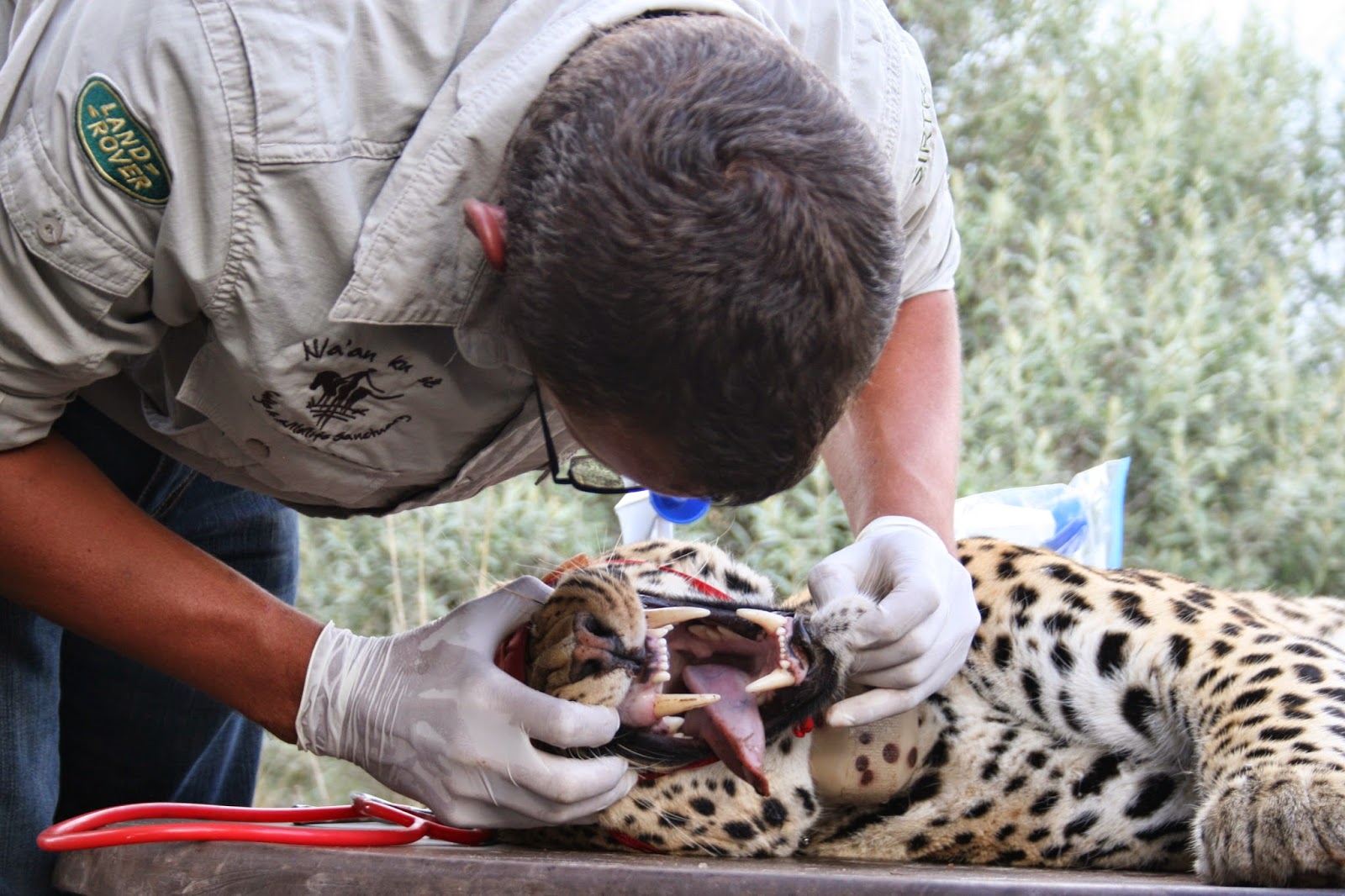
Medical examination of a conflict leopard prior to translocation. The male was moved over 350km and hunted an adult Mountain zebra less than 9 hours after release (Photo: Stuart Munro).
The PhD study takes an in-depth look at the biological and technical components of moving predators from different conflict situations into private and public conservation reserves. Between 2008 and 2014 Florian has spent much time in the field following 30 collared individuals, including 23 cheetahs (+ their 10 cubs), 6 leopards and 1 brown hyena. Amongst other things, he has documented their survival, feeding ecology, movements, post-release conflict involvement and reproduction.


Release of study leopard Pp15. The leopard went on to raise a litter of two cubs which were born only 8 months after release (Photo: Tanja Laschinger).

The article shows that translocations are costly to undertake, i.e. approximately 6,900USD for every successful cheetah and about 3,200USD per a successful leopard, thus limiting the number of translocations that can be carried out on conservation budgets. The single biggest cost element was tracking technology (56%), i.e. fitting released animals with modern VHF and GPS collars. These, however, are necessary to determine whether the relocation was successful or not. Captive time in a rehabilitation centre (for example for confiscated or injured predators) and release mode (either hard release without acclimatisation, or soft release from a specialised holding pen) also influence translocation costs significantly.


When things go wrong – dead study cheetah after trying to defend its first prey against a spotted hyena (Photo: Florian Weise)
Interestingly, the study also describes that a large portion of translocation costs can be recovered from public support (donors and sponsors) because non-lethal management of conflict predators has higher appeal than simply removing offenders or perceived “problem animals”. Effective translocation cost recovery on average was 65% and in many cases over 90%. By sharing monitoring data with affected landowners on a regular basis, Florian also increased the local tolerance of released carnivores within the Namibian farming community. Some collared individuals even became local tourist attractions and therefore provided landowners with an incentive to look after them.
 
A perfect release candidate – male cheetah Aju17 in excellent physical condition. The male had only attacked livestock opportunistically and never resumed conflict behaviour after relocation (Photo: Naankuse Foundation, Namibia)


The paper demonstrates that there are very case-specific elements that impact on overall costs, related to specific management considerations such as translocation distance. Surprisingly, the study provides evidence that translocation as a conflict management strategy is not inherently more expensive than other non-lethal techniques currently employed. The article concludes that the most important consideration to be made before translocation is the selection of appropriate candidate animals. For example, in this study none of the five orphaned, habituated cheetahs survived year one after release, despite being the five most-expensive individuals altogether. Conversely, leopards were far cheaper to translocate and almost twice as successful as cheetahs. 


Florian and an assistant locating released cheetahs via VHF-telemetry in the vast landscapes of south-western Namibia (Photo: Cristina Armesto)
The authors argue that translocation should be an available conflict mitigation tool but the strategy should not be utilised as a standard response to conflict situations. Moreover, to justify high expenses, translocation should be reserved for individuals with high conservation importance, e.g. animals from threatened sub-species/populations. The case scenarios outlined therefore provide valuable baseline information for wildlife managers to improve both accountability as well as responsibility of translocations.


This study was supported by the National Geographic Big Cats Initiative, Chester Zoo, Colchester Zoo, SPOTS Foundation, Bank Windhoek, IDEA WILD, Sea World and Busch Gardens, Land Rover SA, Windhoek Animal Hospital as well as many private individuals.


Florian carried out his research as the principal investigator for the N/a'an ku se Carnivore Conservation Research Project in Namibia; www.naankuse.com 

Tuesday, 15 July 2014

Thick-billed Parrot ‘love-in’

Posted by Francelia Torres and Stuart Marsden

My longest stop in Mexico was a visit to the Pronatura Noroeste (BirdLife partner in Mexico) project on Thick-billed Parrots Rhynchopsitta pachyrhyncha around Madera, Chihuahua. The team, including Francelia Torres, are working on nesting ecology, ranging behaviour and other aspects of the ecology of this Endangered species, work which started in the 1990s by people like Tiberio Monterrubio-Rico, Ernesto Enkerlin Hoeflich, and the current director of Pronatura, Miguel Cruz.


Thick-billed Parrot pair by nest hole in dead Trembling Aspen (Photo: Stu)

The current research is working on several aspects of the species’ ecology, all aimed at stabilising, or hopefully boosting, the numbers of the ‘Cotorra Serrana Occidental’ (as the species is known locally) in the pine forests. These efforts, as with many parrot species, focus on maintaining and, hopefully, increasing reproductive output.

Pine forests of Tutuaca - here the Cotorros nest in huge conifers (Photo: Stu)

Researchers are counting parrots as they arrive at habitual drinking sites. During our visit Eduardo Cortés, a Pronatura biologist, took some high resolution photos of birds arriving at the drinking site, a small waterfall, and could quite easily recognise the white bills of juveniles against the dark ones of adults. This age identification may have useful applications in this population, as it may have with other parrots (see ‘Eyeing up the population structure of Grey Parrots).

A pair looking forward to doing its bit for the survival of the species (Photo: Stu)

They are also looking at feeding ecology. For a species which eats mainly conifer cone seeds, there would seem to be a lot of food in these forests! But a closer look may reveal some more picky selection of trees to feed in, and, possibly, times of the year when food is relatively  
scarce.


Decades of logging has seriously reduced nest hole availability (Photo: Stu)
The main problem, for me, is undoubtedly, the loss of the large conifers through decades of logging. These are the same forests from which the Imperial Woodpecker Campephilus imperialis disappeared. Like many parrots, the availability of large trees with cavities is hugely important. Is the Thick-billed Parrot a colonial nester? Certainly, at the Madera site, nests are in tight clusters centred around stands of large living or dead Quaking Aspens Populus trenudoides, with up to three nests per tree (Monterrubio-Rico et al. 2006).  These congregations certainly feel like colonies, with pairs interacting and bouncing off each other. But at the Tutuaca site, the Cotorras nest in large conifers, Pseudotsuga and Abies, which are not clustered. Pronatura are monitoring a few nests and it will be interesting to see if reproductive output differs between areas where nests are clustered and dispersed.

Above - Nest box positioned in small Pine; 
Below - Manuel climbing to check nest box contents (Photos: Stu)


Designing a strategy for provision of adequate nest holes, be them in large remnant trees or in nest boxes right across the landscape and at minimal cost and management need, may be a priority for research. Forty artificial nests have been in place at Madera since 2008. So far, they have fledged just 45 young parrots (less than 0.2 per nest per year). Although any extra baby parrots are more than welcome, increasing the yield on investment in nest boxes (perhaps around $400 per nest box provision) through better positioning would be good.


The parrot on the right has its wing around the one on the left, which is nice (Photo: Stu)

While logging may have driven down the population over the last century, uncontrolled fires are a very current threat. One such blaze last destroyed tens of nests. In response, Pronatura will place a further 100 nest boxes in Tutuaca and a third site, Papagochi in time for the 2015 breeding season.

At the time of our visit, the Cotorras were winding up for the breeding season. Judging by the behaviour of the pairs, they were looking forward to contributing towards efforts to save the species. Good luck to them and the Pronatura team.


References


Monterrubio-Rico, T.C., Cruz-Nieto, J., Enkerlin-Hoeflich, E., Venegas-Holguin, D., Tellez-Garcia, L. & Marin-Togo, C. (2006). Gregarious nesting behavior of Thick-Billed Parrots, (Rhynchopsitta pachyrhyncha) in aspen stands.  Wilson Journal of Ornithology 118: 237-243.