Sunday, 21 September 2014

Moving Large Carnivores out of trouble

Posted by Florian Weise

Here, Florian, a PhD student working with Martin Jones and Caroline Bettridge in the CEB group, talks about his recent paper in PLoS ONE on the financial costs of Large Carnivore translocations. The paper provides the first detailed cost analysis of carnivore translocations and therefore will help conservation managers make better-informed decisions in the future, especially when budgeting for actions. The paper is open access here. 


With increasing human populations and continuing habitat encroachment, active management of populations of large mammals such as the African big cats is becoming increasingly necessary. A former MMU graduate, Florian Weise, has spent the last 7 years in Namibia studying the conflict between large carnivores and commercial livestock farmers. Namibia still supports healthy free-ranging predator populations and most individuals live outside of formally protected areas on private ranch lands. As a result of persistent conflict on these ranches, dozens (if not hundreds) of large carnivores were haphazardly relocated within the country in the past. However, very little monitoring was carried out and the relocation 'strategy' became more and more controversial. At a wider scale, thousands of large carnivores are translocated throughout Africa each year, with little consideration to cost-effectiveness, and overall efficacy.


Conflict leopard Pp06 caught in a live-trap after killing 12 cattle calves in less than 2 months (Photo: Florian Weise)

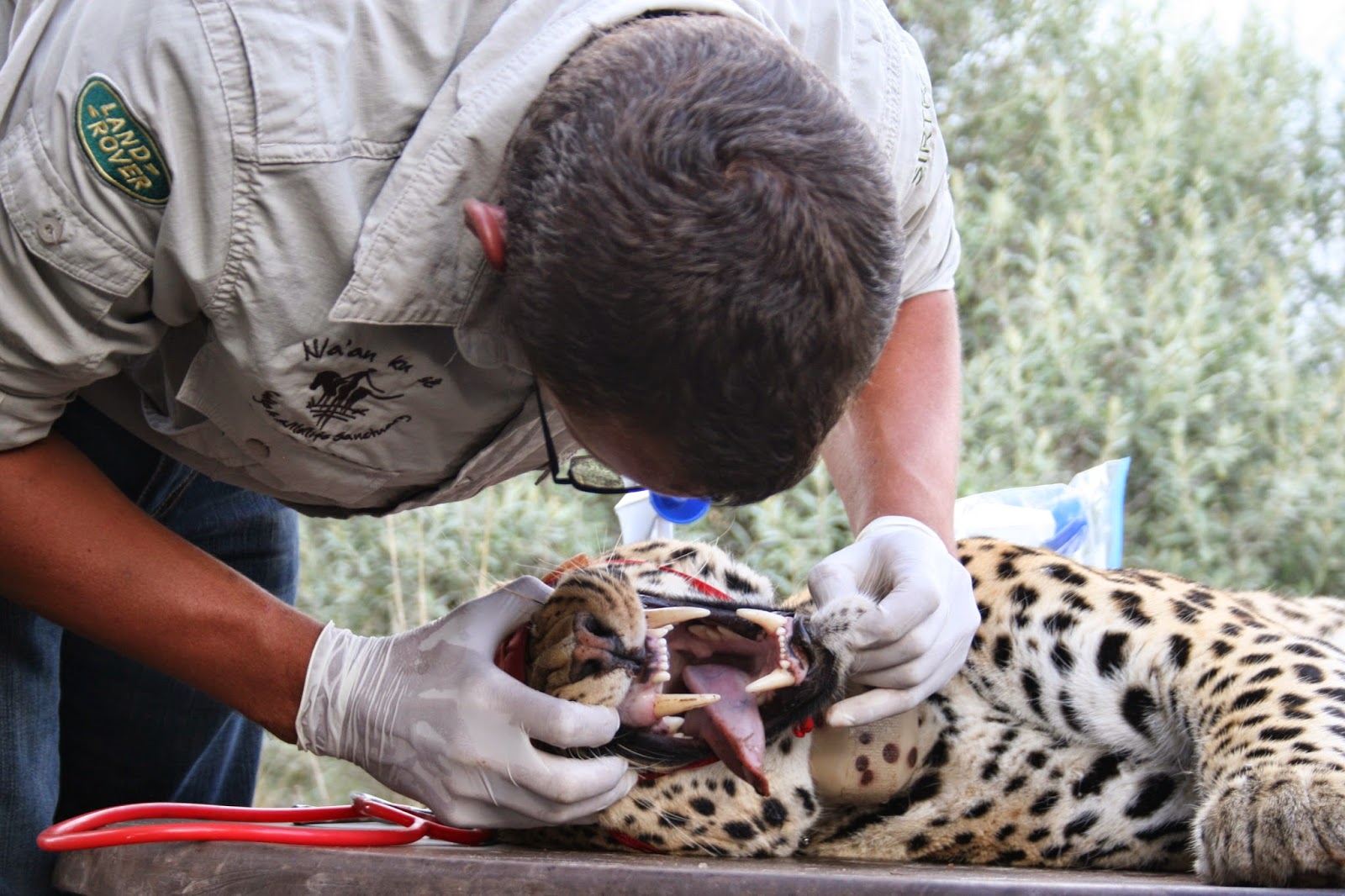
Medical examination of a conflict leopard prior to translocation. The male was moved over 350km and hunted an adult Mountain zebra less than 9 hours after release (Photo: Stuart Munro).
The PhD study takes an in-depth look at the biological and technical components of moving predators from different conflict situations into private and public conservation reserves. Between 2008 and 2014 Florian has spent much time in the field following 30 collared individuals, including 23 cheetahs (+ their 10 cubs), 6 leopards and 1 brown hyena. Amongst other things, he has documented their survival, feeding ecology, movements, post-release conflict involvement and reproduction.


Release of study leopard Pp15. The leopard went on to raise a litter of two cubs which were born only 8 months after release (Photo: Tanja Laschinger).

The article shows that translocations are costly to undertake, i.e. approximately 6,900USD for every successful cheetah and about 3,200USD per a successful leopard, thus limiting the number of translocations that can be carried out on conservation budgets. The single biggest cost element was tracking technology (56%), i.e. fitting released animals with modern VHF and GPS collars. These, however, are necessary to determine whether the relocation was successful or not. Captive time in a rehabilitation centre (for example for confiscated or injured predators) and release mode (either hard release without acclimatisation, or soft release from a specialised holding pen) also influence translocation costs significantly.


When things go wrong – dead study cheetah after trying to defend its first prey against a spotted hyena (Photo: Florian Weise)
Interestingly, the study also describes that a large portion of translocation costs can be recovered from public support (donors and sponsors) because non-lethal management of conflict predators has higher appeal than simply removing offenders or perceived “problem animals”. Effective translocation cost recovery on average was 65% and in many cases over 90%. By sharing monitoring data with affected landowners on a regular basis, Florian also increased the local tolerance of released carnivores within the Namibian farming community. Some collared individuals even became local tourist attractions and therefore provided landowners with an incentive to look after them.
 
A perfect release candidate – male cheetah Aju17 in excellent physical condition. The male had only attacked livestock opportunistically and never resumed conflict behaviour after relocation (Photo: Naankuse Foundation, Namibia)


The paper demonstrates that there are very case-specific elements that impact on overall costs, related to specific management considerations such as translocation distance. Surprisingly, the study provides evidence that translocation as a conflict management strategy is not inherently more expensive than other non-lethal techniques currently employed. The article concludes that the most important consideration to be made before translocation is the selection of appropriate candidate animals. For example, in this study none of the five orphaned, habituated cheetahs survived year one after release, despite being the five most-expensive individuals altogether. Conversely, leopards were far cheaper to translocate and almost twice as successful as cheetahs. 


Florian and an assistant locating released cheetahs via VHF-telemetry in the vast landscapes of south-western Namibia (Photo: Cristina Armesto)
The authors argue that translocation should be an available conflict mitigation tool but the strategy should not be utilised as a standard response to conflict situations. Moreover, to justify high expenses, translocation should be reserved for individuals with high conservation importance, e.g. animals from threatened sub-species/populations. The case scenarios outlined therefore provide valuable baseline information for wildlife managers to improve both accountability as well as responsibility of translocations.


This study was supported by the National Geographic Big Cats Initiative, Chester Zoo, Colchester Zoo, SPOTS Foundation, Bank Windhoek, IDEA WILD, Sea World and Busch Gardens, Land Rover SA, Windhoek Animal Hospital as well as many private individuals.


Florian carried out his research as the principal investigator for the N/a'an ku se Carnivore Conservation Research Project in Namibia; www.naankuse.com 

Tuesday, 15 July 2014

Thick-billed Parrot ‘love-in’

Posted by Francelia Torres and Stuart Marsden

My longest stop in Mexico was a visit to the Pronatura Noroeste (BirdLife partner in Mexico) project on Thick-billed Parrots Rhynchopsitta pachyrhyncha around Madera, Chihuahua. The team, including Francelia Torres, are working on nesting ecology, ranging behaviour and other aspects of the ecology of this Endangered species, work which started in the 1990s by people like Tiberio Monterrubio-Rico, Ernesto Enkerlin Hoeflich, and the current director of Pronatura, Miguel Cruz.


Thick-billed Parrot pair by nest hole in dead Trembling Aspen (Photo: Stu)

The current research is working on several aspects of the species’ ecology, all aimed at stabilising, or hopefully boosting, the numbers of the ‘Cotorra Serrana Occidental’ (as the species is known locally) in the pine forests. These efforts, as with many parrot species, focus on maintaining and, hopefully, increasing reproductive output.

Pine forests of Tutuaca - here the Cotorros nest in huge conifers (Photo: Stu)

Researchers are counting parrots as they arrive at habitual drinking sites. During our visit Eduardo Cortés, a Pronatura biologist, took some high resolution photos of birds arriving at the drinking site, a small waterfall, and could quite easily recognise the white bills of juveniles against the dark ones of adults. This age identification may have useful applications in this population, as it may have with other parrots (see ‘Eyeing up the population structure of Grey Parrots’).

A pair looking forward to doing its bit for the survival of the species (Photo: Stu)

They are also looking at feeding ecology. For a species which eats mainly conifer cone seeds, there would seem to be a lot of food in these forests! But a closer look may reveal some more picky selection of trees to feed in, and, possibly, times of the year when food is relatively  
scarce.


Decades of logging has seriously reduced nest hole availability (Photo: Stu)
The main problem, for me, is undoubtedly, the loss of the large conifers through decades of logging. These are the same forests from which the Imperial Woodpecker Campephilus imperialis disappeared. Like many parrots, the availability of large trees with cavities is hugely important. Is the Thick-billed Parrot a colonial nester? Certainly, at the Madera site, nests are in tight clusters centred around stands of large living or dead Quaking Aspens Populus trenudoides, with up to three nests per tree (Monterrubio-Rico et al. 2006).  These congregations certainly feel like colonies, with pairs interacting and bouncing off each other. But at the Tutuaca site, the ‘Cotorras’ nest in large conifers, Pseudotsuga and Abies, which are not clustered. Pronatura are monitoring a few nests and it will be interesting to see if reproductive output differs between areas where nests are clustered and dispersed.

Above - Nest box positioned in small Pine; 
Below - Manuel climbing to check nest box contents (Photos: Stu)


Designing a strategy for provision of adequate nest holes, be them in large remnant trees or in nest boxes right across the landscape and at minimal cost and management need, may be a priority for research. Forty artificial nests have been in place at Madera since 2008. So far, they have fledged just 45 young parrots (less than 0.2 per nest per year). Although any extra baby parrots are more than welcome, increasing the yield on investment in nest boxes (perhaps around $400 per nest box provision) through better positioning would be good.


The parrot on the right has its wing around the one on the left, which is nice (Photo: Stu)

While logging may have driven down the population over the last century, uncontrolled fires are a very current threat. One such blaze last destroyed tens of nests. In response, Pronatura will place a further 100 nest boxes in Tutuaca and a third site, Papagochi in time for the 2015 breeding season.

At the time of our visit, the Cotorras were winding up for the breeding season. Judging by the behaviour of the pairs, they were looking forward to contributing towards efforts to save the species. Good luck to them and the Pronatura team.


References


Monterrubio-Rico, T.C., Cruz-Nieto, J., Enkerlin-Hoeflich, E., Venegas-Holguin, D., Tellez-Garcia, L. & Marin-Togo, C. (2006). Gregarious nesting behavior of Thick-Billed Parrots, (Rhynchopsitta pachyrhyncha) in aspen stands.  Wilson Journal of Ornithology 118: 237-243.

Friday, 27 June 2014

Amphibian declines in Bale, Ethiopia

Posted by Michele Menegon

The creation of a new road in the Bale Mountains, Ethiopia, in the 1980s gave herpetologists a rare opportunity to study amphibians in the area. Michele, a PhD student in the research group, was part of a team which recently repeated Amphibian surveys first done in 1986. The team found some potentially very serious declines in amphibians from the area. Results have recently been published in the journal Oryx.


The Bale Mountains

The Bale Mountains lie in southern Ethiopia, east of the Rift Valley. The Mountains rise to nearly 4,400 m, and the extensive massif has a rich flora and fauna, including many unique, rare, spectacular and threatened taxa. Hillman (1986) considered the Mountains ‘a centre of faunal endemicity, probably with the highest rate of animal endemicity for a terrestrial habitat anywhere in the world’.

Ethiopian wolf (Canis simensis) one of the many endemics of the Bale Mountains (Photo: Paul Donald)


The highest part of the region, the Sanetti Plateau and associated peaks, comprises Afroalpine grasslands but to the south is the Harenna escarpment that drops from 3,200 to 2,000 m in just 8 km. A substantial area (c. 2,200 sq km) of the region is covered by the Bale Mountains National Park, established in 1971 but not yet formally gazetted by the Ethiopian government.


Forest alteration in Harenna Forest (Photo: M. Menegon)


Bale’s frogs and toads

Despite a long history of human habitation in the area, the Bale Mountains remained largely unexplored scientifically until the middle of the 20th century. W.H. Osgood, from the Chicago Field Museum,  collected some amphibians and reptiles in 1926–1927, and M.J. Largen and colleagues carried out extensive collections between 1971 and 1975. Early collecting expeditions were centred around Dinshu and the northern slopes below the Sanetti Plateau.

Around 15 amphibian species (all anurans) have been reported from the Bale Mountains, including 10 endemics (Largen, 2001; Largen & Spawls, 2010). The Bale Mountains National Park is an ‘Alliance for Zero Extinction’ site (http://www.zeroextinction.org), partly because of its threatened amphibians (Alliance for Zero Extinction, 2010). Given the Park’s importance for their conservation, we focus here on four monotypic frog genera: all endemic to Ethiopia and three endemic to the Bale Mountains.


Bale mountains moss frog (Balebreviceps hillmani)  (Photo: M. Menegon)

The survey and re-survey

In 1983, when a new road was constructed through the forest, it became possible to reach the Harenna Forest, on the southern side of the massif. Conscious of the conservation threat posed by the new road, the Ethiopian Wildlife Conservation Organization arranged an expedition with Addis Ababa University to conduct a preliminary survey of the Harenna Forest in August 1986. During a meeting in London a few years ago, Dr. Largen said that all the species discovered during the 1986 expedition were abundant, or very abundant, and that they often were seen, directly from the car, moving around the vegetation right by the side of the road.

In 2009, I was part of a team of five researchers, David Gower from the NHML, U.K. Simon Loader and Abebe Mengistu from University of Basel, Switzerland, and Rafael de Sa from University of Richmond, U.S.A. We spent around one month surveying frogs both in Bale Mountains and some of the western forests around the town of Bonga. This survey gave us the opportunity to re-survey frogs in the areas first surveyed in 1986. At that time, frogs were easy to find along the newly cut road – the surveyors could simply stop their car and collect many species of frogs right by the side of the road.


Altiphrynoides malcolmi:  a genus endemic to Bale Mountains (Photo: M. Menegon)

The results of our re-survey are presented in an Oryx paper. We present long-term quantitative data (individuals encountered per person hour of searching) for four monotypic frog genera endemic to an Afromontane region of exceptional importance, but growing conservation concern. These include one endemic to the Ethiopian highlands Altiphrynoides osgoodi and three endemic to the Bale Mountains: Altiphrynoides malcolmi; Balebreviceps hillmani; and Ericabatrachus baleensis; all collected during 15 field trips to the Bale Mountains between 1971 and 2009.

Only a single confirmed sighting of S. osgoodi has been made since 1995. The other three species have also declined, at least locally. E. baleensis appears to have been extirpated at its type locality and at the same site B. hillmani has declined. These declines may be associated with substantial habitat degradation caused by a growing local human population. Chytrid fungus was also found on several frog species in Bale, although no dead or moribund frogs have yet been encountered. These results mean there is an urgent need for more amphibian surveys in the Bale Mountains. Additionally, we argue that detrimental human exploitation must be halted immediately in at least some parts of the Harenna Forest if a local, and hence global, conservation crisis is to be averted.


Balebreviceps hillmani  (Photo: M. Menegon)


References

Alliance for Zero Extinction (2010) 2010 AZE Update. http://www.zeroextinction.org 

Gower, D.J., Aberra, R.K., Schwaller, S., Largen, M.J., Collen, B., Spawls, S., Menegon, M.,
Zimkus, B.M., De Sá, R., Mengistu, A., Gebresenbeta, F., Moore, R.D., Saber, S.A.  and Loader, S.P. (2013) Long-term data for endemic frog genera reveal potential conservation crisis in the Bale Mountains. Ethiopia. Oryx 47(1):56–59

Hillman, J. (1986) Bale Mountains National Park. Management Plan. Ethiopian Wildlife Conservation Organization, Addis Ababa, Ethiopia.

Largen, M.J. (2001) Catalogue of the amphibians of Ethiopia, including a key for their identification.Tropical Zoology, 14:307–402.

Largen, M.J. & Spawls, L. (2010) The Amphibians and Reptiles of Ethiopia and Eritrea. Chimaira, Frankfurt Am Main, Germany.

Saturday, 7 June 2014

Has Worthen's Sparrow had its chips?

Posted by Irene Ruvalcaba Ortega, Ricardo Canales, José I. González and Stuart Marsden

Stu has recently been in Mexico working with research groups from three universities along with a team from Pronatura (the BirdLife partner) on research into some of the country’s most threatened birds. These included the northern population of the Sierra Madre Sparrow Xenospiza baileyi, the Baja endemic Belding’s Yellowthroat Geothlypis beldingi and the pine-loving Thick-billed Parrot Rhynchopsitta pachyrhyncha (all Endangered).


But first up was the Worthen’s Sparrow Spizella wortheni, a charming but Endangered bird of the shrub-grasslands of the northern states of Coahuila and Nuevo León. A major threat to the sparrow is the expansion of potato-growing in the region. Here, Irene Ruvalcaba Ortega, Ricardo Canales, and José I. González from Laboratorio de Biología de la Conservación y Desarrollo Sustentables (UANL) and I talk about the conservation biology of the species, and a project that we hope to initiate that will help secure its near future. 


The Endangered Mexican endemic Worthen's Sparrow Spizella wortheni (Photo: Ricardo Canales)

Worthen’s sparrow, a relative of the semi-migratory Field Sparrow Spizella pusilla, was first described from New Mexico, USA, in the 1880s – this remains the only record of Worthen’s from outside ‘old’ Mexico. The last 100 years or so has seen its range contract so much that it known now from just a few sites in two of Mexico’s northern states. BirdLife’s assessment is that there may be as few as 100 mature individuals - although they point out that there is scope to find new populations in this vast landscape.

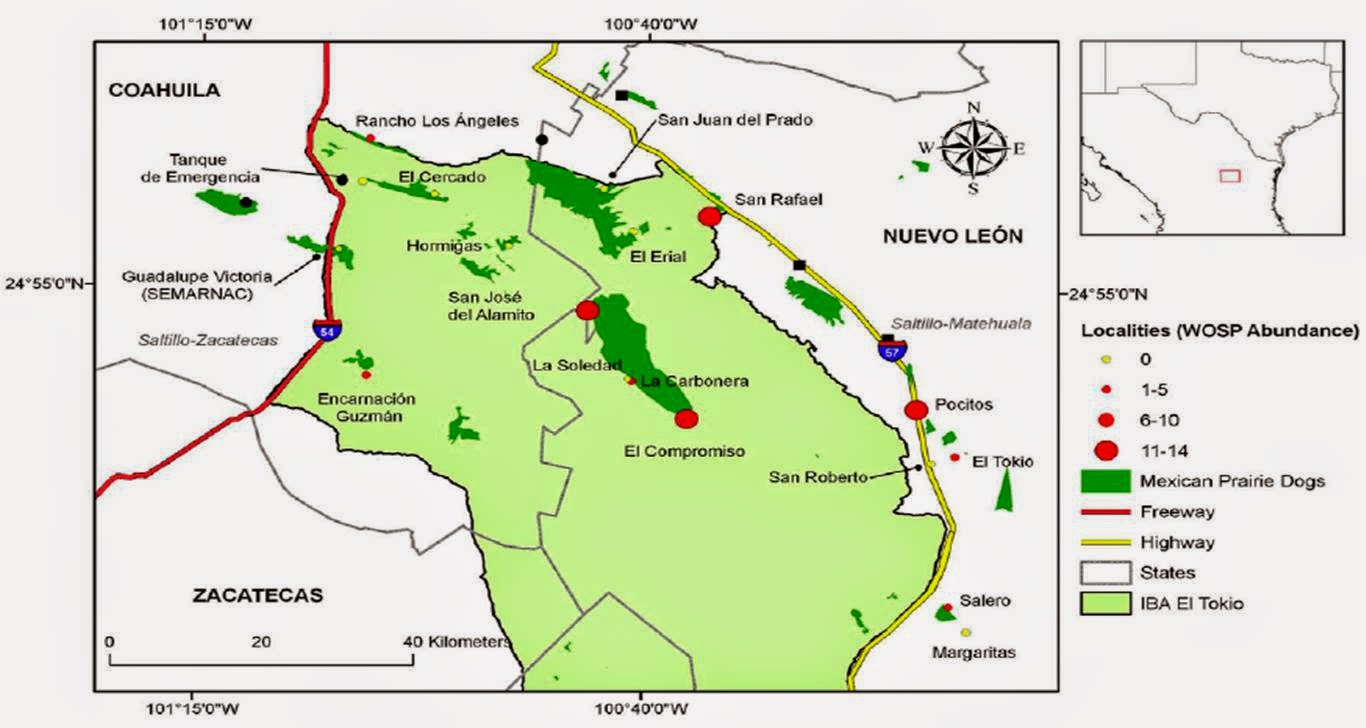
Following discussions at the Universidad Autonóma de Nuevo Leon, where much of the recent research on the species has been carried out, we headed out into the field, joined by Hugo Elizondo, a research assistant who has seen more Worthen’s in the wild than anyone. Work by the group has found several new sites for the species and important new breeding areas (Canales-del Castillo et al. 2010). There may be more undiscovered populations – some areas cannot be visited due to security problems associated with Mexico’s cartels.


The main areas where Worthen's Sparrow are known to occur. New sites are being found, but search efforts are hampered by security issues.
The main habitat of the sparrow is centred around large flat basins, very shallow valleys surrounded by higher ground with Juniper bushes holding Bushtits, and Black-chinned and Black-throated Sparrows. On the flat ground are extensive colonies of the Endangered Mexican Prairie Dog Cynomys mexicanus. Also eating grass are cows, sheep, Black-tailed Jackrabbit and Eastern Cottontails. This is one of those landscapes where everywhere looks the same or every hectare of it looks different – depending on how closely you look. Reconstructing the history of human use of these areas, and identifying the main natural and anthropogenic gradients within the area may be one of the keys to understanding the sparrow’s past, present and future. 

Worthen's sparrow in typical nesting habitat (Photo: Ricardo Canales)
We visited some areas of grassland which are used by flocks of Worthen’s in the non-breeding season. They are nomadic and seem to appear in different areas in different years – this may serve them well as the landscape is constantly changing (e.g. Canales-Delgadillo et al. 2012). Areas are ploughed for growing potatoes, some areas we visited were lush after the rain, others inexplicably dry. Next, we saw 10-15 breeding pairs in a small area of great habitat in La Soledad. Nests were relatively easy to locate, placed 5-30 cm above the ground in the centre of Tarbushes Flourensia cernua and Creosotebushes Larrea tridentata, sometimes with Opuntia sp. Research by UANL suggests that nesting success can be low, perhaps due to predation by snakes, birds etc – intensive study of the factors which affect recruitment should clearly be a key component of further study.
Worthen's nesting habitat at Museo de las Aves de Mexico's La India reserve (Photo: Stu)
Over the two days, we also visited some small reserves, and an area of abandoned crops, which still held a pair of sparrows in a tiny remnant patch of habitat. A collaborator on our planned project will be Museo de las Aves de Mexico www.museodelasaves.org, a museum in the historical city of Saltillo, dedicated to birds. We visited their extensive protected area and research site at La India, where several pairs of Worthen’s were found breeding in a bush-grassland habitat subtly different from that in La Soledad. A comparison of ecology and breeding success in the two differently managed areas would be invaluable.
 

Our immediate aim is to get a Mexican PhD student, supported by Masters and Undergraduate students working on Worthen’s and its habitat.


References

Canales-Delgadillo, J.C., Scott-Morales, L. & Korb, J. (2012). The influence of habitat fragmentation on genetic diversity of a rare bird species that commonly faces environmental fluctuations. Journal of Avian Biology 43: 168-176.


Canales-del Castillo, R., Gonzalez-Rojas, J.I., Ruvalcaba-Ortega, I. & Garcia-Ramirez, A. (2010). New breeding localities of Worthen's Sparrows in northeastern Mexico. Journal of Field Ornithology 81: 5-12.

Tuesday, 20 May 2014

A dietary check-up for parrots in the western Amazon

Posted by Alan Lee


In a recently published paper, Alan, Stu and others report on an intensive study of the diets of a range of parrots in Peru. Dietary data of this sort are rare – seldom are the resources/person-power available to accumulate the data, and studying diets is not always seen as a fashionable way to go about ecology. Here, Alan talks about the study, its making, and its findings.


Parrots have good manners – they don't tend to speak with their mouths full. That makes them a bit hard to find when foraging quietly in the upper canopy. Luckily, they are messy eaters, and fruit fall invariably leads the observer to something frugivorous, be it a Red-howler monkey (Alouatta seniculus), Spix's Guan (Penelope jacquacu), Curl-crested Aracari (Pteroglossus beauharnaesii) or one of the 20 odd species of parrot – if you happen to be looking for them in the lowland Amazon rainforests of Peru. Together with people from all walks of life, I registered birds eating food for over two years, amassing a data set of over 1500 encounters with foraging parrots. 

Aldo, Philip, and Percy test what the macaws have been eating (Photo A. Lee)

One of the first things we noticed was that these birds prefer to forage from the same individual trees – usually amongst the largest tree (adults, and at least at canopy level). For the sake of independent samples, many of these repeat encounters needed to be omitted – but they accounted for over 10% of all encounters. We would place foraging tape on trees marked when a foraging encounter had been recorded, and soon some of the more frequently walked trails were decorated with registrations. 

A foraging event, the left over breakfast: macaws cracked open and at the seeds from this noxious vine (Photo A. Lee)

To account for the fact that we may be missing birds foraging on smaller items, like small fruit and flowers, we also watched birds from canopy towers, as well as when floating down the river by boat to town from our study sites along the Tambopata River. Rather unsurprisingly given the difference in sizes of the parrots involved, we found that different parrots fed on different plant species and reproductive parts. For example, while all parrots fed on Brazil nut trees, large macaws with their powerful beaks went for the developing seed pods, while the smaller parrots fed on the flowers. All parrots loved the fruits and seeds of the Wasai palm.


While the colourful or endangered macaws
are most frequently photographed at
claylicks, its the little and common
Dusky-headed parakeets that
visit in greatest numbers.

(Photo A. Lee)


One of the main reasons we were recording foraging events was to document what plant parts were being consumed (e.g. fruit pulp or seeds) and whether the fruit were ripe or unripe. We were expecting that our records of surveys of the geophagy sites in the area (claylicks where birds would eat soil) should indicate those birds that eat more seeds and unripe food items should be those that eat more soil, if the theory held that the clay binds dietary toxins. This is because unripe fruit and seeds tend to have higher quantities of tannins and other things that make the unripe fruit taste unpleasant – at least to us. This is because the plants don't want to have their reproductive bits eaten after all.


Red-and-Green Macaws at a claylick
on the Los Amigos River (Photo A. Lee)


In addition to the fun task of watching parrots feasting, we also undertook the more onerous task of recording the fruiting status of 1800 individually marked trees every month. We did this to understand phenology patterns – to identify if there were any periods with little food availability that could perhaps drive the parrots to consume soil in the absence of food. Although there was a clear pattern of peak flowering and fruiting seasons, there was something fruiting of flowering throughout the year, especially if we concentrated only on the plant species the parrots preferred to forage on. So there is no evidence that these parrots eat soil due to bottlenecks in food availability.


We had previously worked out bird densities for the region by conducting line transects at multiple sites in the area (http://onlinelibrary.wiley.com/doi/10.1111/j.1744-7429.2011.00847.x/abstract), so we could calculate an estimate for the population of birds that were in the vicinity of a claylick i.e. the audience. What we found when we divided upper estimates of the numbers of birds feeding on the clay by the local population, was that the macaws – the parrots most famous for eating seeds and unripe fruit items – in fact did not consume more clay than expected. Surprisingly, it was the parakeets associated with secondary forests – Dusky-headed (Aratinga weddellii) and White-eyed parakeets (Psittacara leucophthalma) – that were represented on the claylicks more than expected. 


In the popular literature claylicks are associated with, and illustrated by, the large and colorful members of the parrot family - the macaws (Photo A. Lee)


Furthermore, our foraging encounters also suggested that these birds ate more flowers – specifically balsa flowers (Ochroma pyramidale) – than seeds. In addition, those species that were associated with terra-firme forests (White-bellied parrots Pionites leucogaster and Orange-cheeked parrots Pyrilia barrabandi) were observed less frequently on claylicks. 
Most publications investigating patterns of clay consumption or reasons for clay consumption from the Peruvian Amazon have concluded that they do it for the sodium. Our dietary study at least does not support the alternative hypothesis – that they do it to counter dietary toxins. 

The research has been funded by:


Friday, 2 May 2014

Our Sangihe and Talaud project takes off

Posted by Stuart Marsden and Hanom Bashari

First, I’m delighted to say that the Rainforest Trust and Loro Parque Fundacion have agreed to fund our project on Sangihe and Talaud. The project will be undertaken in partnership with Burung, the Indonesian BirdLife partner. The bulk of the work will be done by Rob Martin (currently at BirdLife in Cambridge), who will start an MPhil/PhD here at MMU in July, under the supervision of Stu, Elias Symeonakis (MMU), and Nigel Collar of BirdLife. Working alongside Rob will be Hanom Bashari of Burung. 


Above - The Sangihe endemic and Endangered Elegant Sunbird Aethopyga duyvenbodei (Photo: Hanom Bashari). Below - Nutmeg, which along with Cloves are a major source of income for the people of Sangihe and a major impact on the forest (Photo: Stu)

Stu has recently returned from a trip to Sangihe and Talaud, where I was accompanied and looked after by Hanom. We first spent some time at Burung’s headquarters in Bogor discussing the project with Agus Budi Utomo, Burung’s chief and Ria Saryanthi. I had the opportunity to give a presentation to Burung staff and local graduates about our work at MMU, and particularly our research on tropical frugivores inside and outside of protected areas.


Above - Another Sangihe endemic, the Sangihe Kingfisher (Photo: Hanom Bashari). Below - Forest gardens on Sangihe. It could be that with a bit of tweaking, some of these habitats might be important for some of the endemics (Photo: Stu)

It seemed to take an age to get to the forest on Sangihe. The terrain is incredibly steep – that is partly why forest remains there when it has given way to clove, nutmeg and coconut plantations elsewhere on the island. We started searching for the Cerulean Paradise Flycatcher at Mount Awu – in forest which was heavily degraded. We didn’t find the bird but there were 1-2 valleys which contained habitat that might be ‘nearly good enough’ for the species. In fact, this seems to be a possible theme for our research….how can small changes to the way people use the forest yield significant increases in an area’s suitability for birds? It may be that creating buffers of lesser-used habitat around streams might be a potential way forward.


Above - Cerulean Paradise-flycatcher Eutrichomyias rowleyi and Below Sangihe Shrike-thrush Colluricincla sanghirensis both Critically Endangered (Photos: Hanom Bashari)

Our main recce was at Sahendaruman, where we did see the flycatcher in incredibly steep valleys. There aren’t many birds in these forests – particularly, a lack of monarchs, fantails, white-eyes etc means that mixed species flocks do not seem to develop. A clamber up the steep valley sides took us to the ridge tops – where the interesting-looking Sangihe Shrike-thrush was seen, but no Bulbul and definitely no white-eye.


Ridge forest on Sangihe (Photo: Stu)
Then on to Talaud. This is a very different island, relatively low-lying and ‘non-volcanic’. I has a nice almost  ‘Caribbean-like feel to it. We didn’t have time to get to the primary forests in the island’s interior, where there may be lots of birds and maybe new discoveries to be made, but the garden-type habitats and forest fragments we did visit were birdy. Talaud Rail, Talaud Kingfisher and the ‘new’ pitta were seen, although the only bushhens I saw were five Rufous-tailed Waterhen Amaurornis moluccana. Parrots, including the ‘Sampiri’ (Red-and-blue Lory Eos histrio) were reasonably common and we saw at least two of the Tanygnathus and the racquet-tail Prioniturus platurus.

The endemic and Near-threatened Talaud Kingfisher Todiramphus enigma (Photo: Hanom Bashari)

We visited a Sampiri roost and interestingly, we got the chance to talk to Pak Zaka, a very nice and very knowledgeable parrot trapper-turned-conservationist. My first question was “Are lories rarer now than they were 20 years ago? (when he worked with Jon Riley and Jim Wardill of ‘Action Sampiri’). His answer was quite surprising and incisive. “It is odd…that 20 years ago there were lots of parrot trappers, and year after year there were lot of lories. Now, at a time when there are few trappers, there are few lories. The reason? There are so many chainsaws….people cutting down the big trees that the lories need for nesting. The lories have gone into the big forest in the interior”. 

Red-and-blue Lories Eos histrio - Endangered (Photo: Hanom Bashari)

Finally, I got to visit WCS’s Maleo project in NE Sulawesi and even got to release two baby Maleos. A couple of days searching for Sulawesi endemics at Mount Mahawu and Dumoga Bone NP yielded Scaly-breasted Kingfisher, Rufous-throated Flycatcher, Maroon-chinned fruit dove, some nice owls, Blue-eyed Rail, and several other Wallacean treats.


The Sangihe Hanging-parrot Loriculus catamene is Near-threatened (Photo: Hanom Bashari)

A big thanks to all those kind folk we met along the way. 


Our project on Sangihe and Talaud is sponsored by